Composers · Romantic
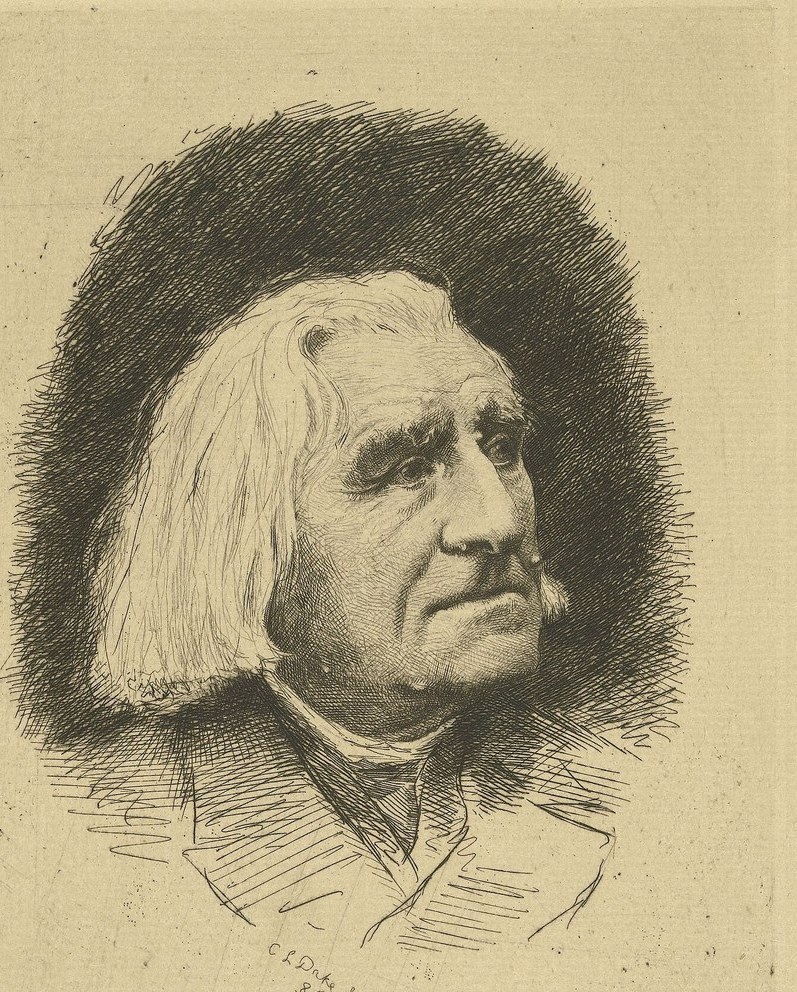
Franz Liszt
Liszt Ferenc
- Life
- 1811–1886
- Born in
- Raiding, in today's Austria
- Era
- Romantic
The story of Liszt
A European concert hall in the 1840s. When the long-haired pianist walked on stage, the audience stirred, and after the concert people reportedly fought over the gloves or handkerchief he left behind. The poet Heinrich Heine named this frenzy "Lisztomania." This is Franz Liszt.
The Hungarian prodigy
Liszt was born in 1811 in Raiding, Hungary. His father was a steward on an Esterházy estate and an amateur musician. Recognizing his son's gift, he arranged concerts for the nine-year-old that won aristocratic patronage, and the family moved to Vienna. There Liszt studied piano with Czerny and composition with Salieri.
Paris and Paganini
Around twelve, Liszt moved with his family to Paris. He made his name as a prodigy there, but lost his father in his mid-teens and drifted for a while in deep despondency. In 1832, at twenty, he heard the violinist Paganini and resolved to reach such heights on the piano, practicing ferociously.
Around then he spent several years in Switzerland and Italy with Countess Marie d'Agoult, and they had three children. One daughter, Cosima, later married the conductor Bülow and then became the wife of Liszt's friend Wagner.
The touring years
From 1839, for nearly eight years, Liszt toured all over Europe giving hundreds of concerts. He is credited with establishing the "recital," in which one pianist fills the stage alone. He gave much of what he earned to charity and public causes, including a large contribution toward the Beethoven monument in Bonn.
Music director in Weimar
In 1848 Liszt gave up the glittering touring life and became court music director in Weimar. He energetically staged the works of new composers, including the premiere of Wagner's opera Lohengrin. He himself opened a new form, the "symphonic poem," which depicts stories such as poems or paintings in orchestral music. Instead of a fixed set of movements, a single theme changes shape as it follows the story, an idea that passed on to many composers of later generations.
Monk in Rome
In the 1860s Liszt moved to Rome and took minor orders in the Catholic Church, afterwards called "Abbé Liszt" and wearing a cassock. Even so, he moved between Rome, Weimar and Budapest teaching crowds of young pianists, famously without charging them fees. In 1886 he visited the Bayreuth Festival, then run by his daughter Cosima, and died there at seventy-four.
Music to hear on Pyeongeum
- La Campanellathe song of the little bell, Paganini's melody brought to the piano.
- Liebestraum No. 3a lyrical piece transcribed from his own song.
Hearing the dazzling La Campanella and the singing Liebestraum in turn, you see Liszt's two faces: the star of the stage and the poet.
People around him
- Carl CzernyBeethoven's pupil, who taught the young Liszt.
- Marie d'Agoultthe countess and writer with whom he lived and had three children.
- Richard Wagnerthe composer Liszt helped by premiering his work, and later his son-in-law.
- Countless pupilsthe young pianists Liszt taught without charge.
A question to think about
Liszt gave the fortune he earned from performing to charity and public causes, and in later life charged his pupils nothing. Successful people giving back to society is still much discussed today.
Should what highly successful people give back to society be a personal choice, or a responsibility society can rightly ask of them?
Hidden stories about Liszt
Composers of the same age
People whose lives overlapped with Liszt's by more than ten years