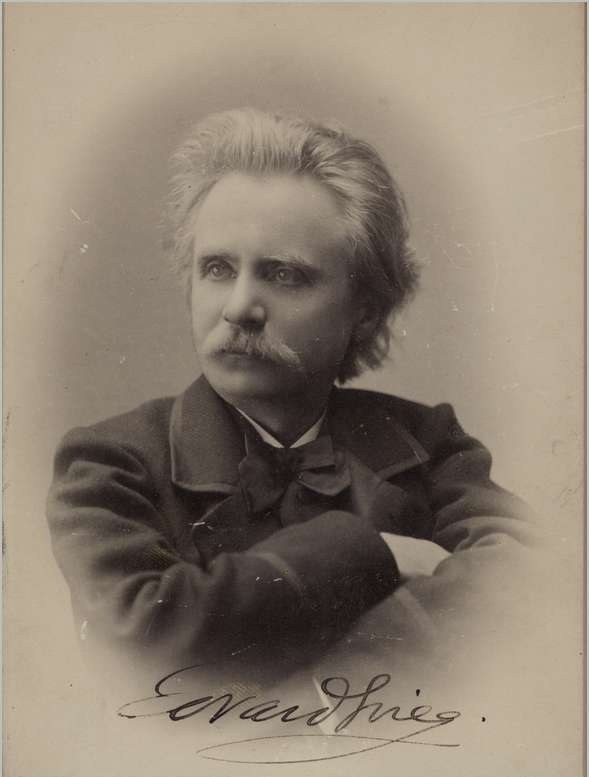
The story of Grieg
Summer 1858. A famous visitor arrives at a house in Bergen, Norway: Ole Bull, the Norwegian violin virtuoso. Hearing a fifteen-year-old boy play the piano and his little compositions, Bull urged the parents to send the boy to Leipzig in Germany to study music. Edvard Grieg's path was set that day.
The boy from Bergen
Grieg was born in 1843 in Bergen, a port city on Norway's west coast. His mother was a pianist and gave him his first lessons. The boy, it is said, preferred searching for chords of his own at the piano to schoolwork.
Study in Leipzig
On Bull's advice, Grieg entered the Leipzig Conservatory at fifteen. The strict German teaching did not suit him, and he later remembered those years without much fondness. During his studies he also suffered a severe bout of pleurisy that damaged one lung, leaving him short of breath for life. Still, there he absorbed the music of Schumann and Mendelssohn deeply.
Finding Norway's voice
After his studies, Grieg met the young Norwegian composer Rikard Nordraak in Copenhagen. Nordraak argued passionately that a Norwegian composer should find music in Norway's folk songs and dances. The meeting changed Grieg profoundly. Nordraak died at twenty-three, but his conviction lived on in Grieg's music for life.
Nina and first success
In 1867 Grieg married his cousin Nina Hagerup, a fine singer who would always be the finest interpreter of his songs. The next year their daughter Alexandra was born, and that summer he wrote his Piano Concerto. But the girl died just past her first birthday. The couple never had another child.
Peer Gynt and the Lyric Pieces
In 1874, at the request of the playwright Ibsen, Grieg wrote music for Peer Gynt. "Morning Mood," "Solveig's Song" and "In the Hall of the Mountain King" have come to define his name. Over his life he also published sixty-six short piano pieces in ten books of Lyric Pieces, capturing Norwegian dances, landscapes and everyday scenes.
Troldhaugen
In 1885 Grieg built a house on a seaside hill near Bergen and named it Troldhaugen, "troll hill." He kept a small composing hut by the water below the house and wrote there. After touring Europe as pianist and conductor, he died in Bergen in 1907 at sixty-four. He and Nina rest together in a tomb in the rock at Troldhaugen.
Music to hear on Pyeongeum
- From Peer Gynt"Morning Mood," "Solveig's Song," "In the Hall of the Mountain King."
- Piano Concerto in A minor, first and third movements.
People around him
- Ole Bullthe violin virtuoso who persuaded his parents to send him to Leipzig.
- Rikard Nordraakthe friend who awakened him to seek Norway's sound.
- Nina Grieghis wife and the singer of his songs.
- Henrik Ibsenthe playwright who entrusted him with the music for Peer Gynt.
A question to think about
Grieg used a musical language learned abroad to rewrite his country's folk songs and dances, and his music made little Norway known to the world. Today the cultures of small countries and regions are easily drowned out by those of larger ones.
Amid globalization, what is needed for the cultures of small countries and regions not to lose their own voice?
Pieces by Grieg
Hidden stories about Grieg
Composers of the same age
People whose lives overlapped with Grieg's by more than ten years