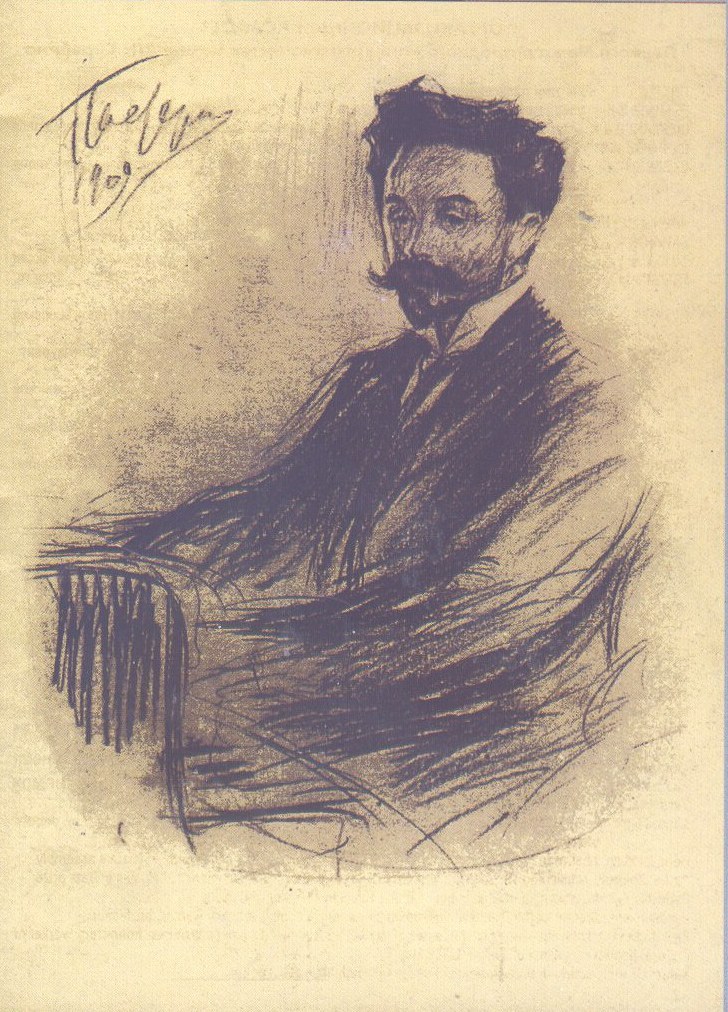
The story of Scriabin
March 1911, a concert hall in Moscow. On stage are an orchestra and a piano, and in the score there is a part for a strange instrument, imagined to give off colored light instead of sound when its keys are pressed. The composer liked to say that he saw a color for each key. His name is Alexander Scriabin.
A child raised by his aunt
Scriabin was born in Moscow in 1872. His mother, a pianist, died of tuberculosis when he was about one, and his father, a diplomat, worked abroad. The boy was raised by his aunt and grandmother. His aunt taught him the piano, and it is said he loved the instrument so much as a child that he would kiss it.
Cadet school and the Conservatoire
Following family tradition he entered a military cadet school in Moscow, but he never gave up music. He studied piano with Nikolai Zverev, who also taught Rachmaninoff. In 1888 he entered the Moscow Conservatory to study piano and composition, and in 1892 he graduated with a gold medal in piano. The same year Rachmaninoff received the larger gold medal.
The injured right hand
While at the Conservatory he practiced difficult pieces too hard and injured his right hand, a blow to his future as a pianist. During that time he wrote a Prelude and Nocturne for the left hand alone. Fortunately the hand recovered, and he went on to perform as a pianist playing his own music.
On Chopin's path
The young Scriabin loved Chopin deeply. The publisher Mitrofan Belyayev recognized his talent, published his music and helped him tour. His Twenty-Four Preludes, Op. 11, which appeared in 1897, travel through all twenty-four keys, as Chopin's had. That same year he married the pianist Vera Isakovich, and from the following year he taught piano at the Moscow Conservatory for several years.
A dream of light and sound
In the 1900s Scriabin's music changed greatly. He became absorbed in philosophy and mysticism and believed that music could transform the human spirit. His private life changed too: he left his first family and began a new life with Tatiana Schloezer. In 1908 he finished the orchestral Poem of Ecstasy, and in 1910 Prometheus, whose score includes a separate part for a keyboard instrument that projects colored light.
The unfinished Mysterium
His last dream was a vast work called Mysterium, to be performed in the Himalayas, joining music, dance, light and even scent. But in 1915 a sore on his lip became infected, and he died in Moscow at forty-three. After his death Rachmaninoff gave concerts of Scriabin's music alone in memory of his friend.
Music to hear on Pyeongeum
- Prelude in E majorthe ninth of the Twenty-Four Preludes, Op. 11, a short piece marked Andantino, flowing a little slowly.
It lasts only about a minute and a half, but in the way the harmonies glide softly from one to the next you can hear what the young Scriabin learned from Chopin. As you listen, think about where this composer, who would later try to join light and sound, first set out from.
People around him
- Sergei Rachmaninoffa fellow student under the same teacher, and a rival.
- Mitrofan Belyayevthe publisher who printed his music and supported his tours.
- Lyubov Scriabinathe aunt who raised him and was his first piano teacher.
A question to think about
Scriabin said he saw colors in sounds, and he dreamed of works that used music and light together. Even hearing the same sound, people call up different things.
When you hear a piece of music, do colors, scenes or smells come to mind? Is it possible to share senses that each person feels differently through a single work?
Pieces by Scriabin
Composers of the same age
People whose lives overlapped with Scriabin's by more than ten years