The story of Rachmaninoff
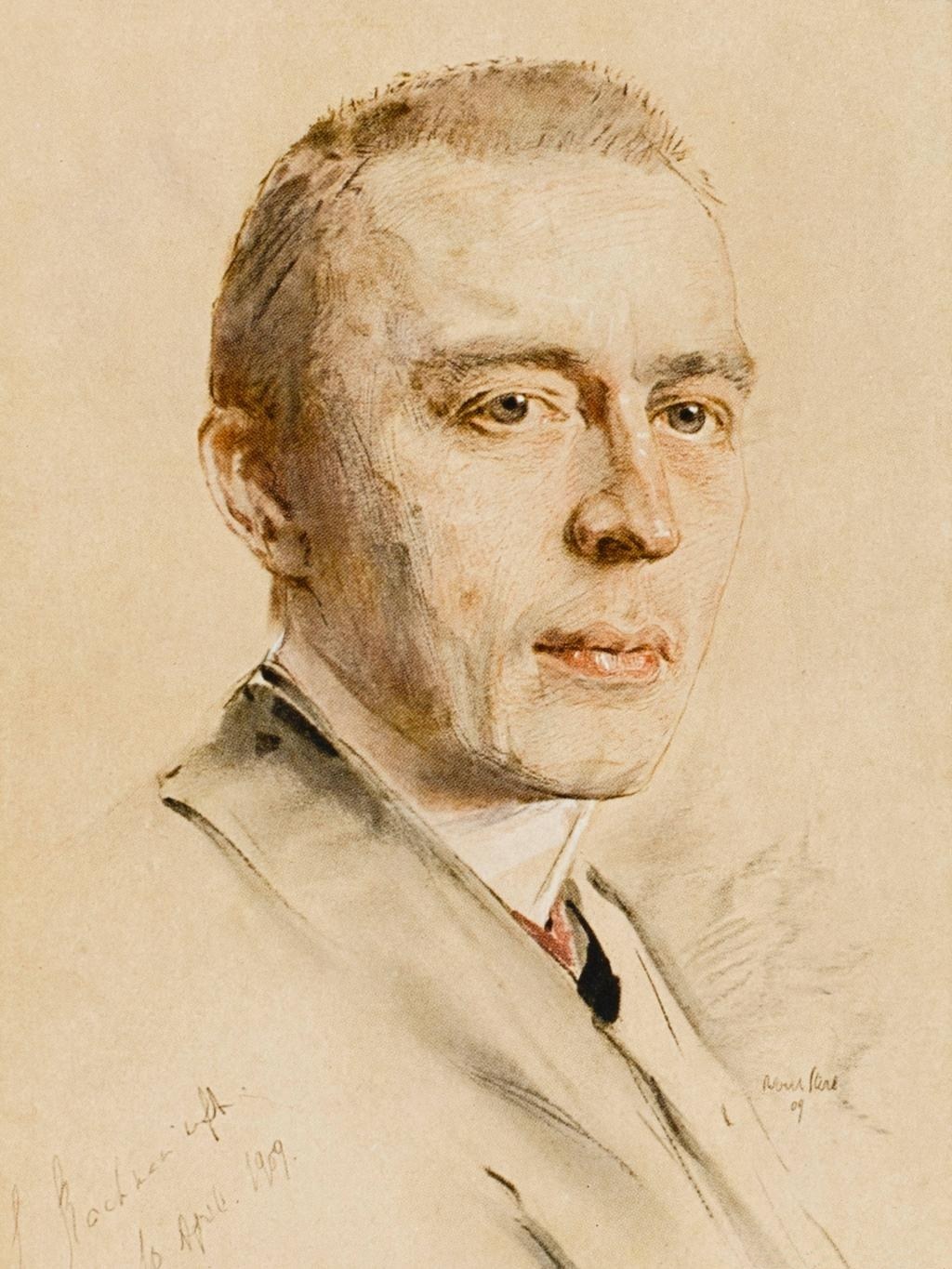
December 1917, a snowy Russian border. A forty-four-year-old composer boards a train with his wife, two daughters and a few small bags, weeks after revolution had turned the country upside down. He said he was leaving on a short concert tour, but he never set foot on his native soil again. This is Sergei Rachmaninoff.
A declining family
Rachmaninoff was born in 1873 into a noble family near Novgorod in Russia. But his father failed to hold on to the family's wealth; estates were lost one by one, and his parents separated. The bells and chants of the churches he attended with his grandmother, it is said, sank deep into the boy's ears.
A strict teacher
As a boy he attended the St Petersburg Conservatory but neglected his studies and got poor marks. On the advice of his cousin Alexander Siloti, a pianist and pupil of Liszt, he moved into the home of Nikolai Zverev, a stern Moscow piano teacher, living and studying with him. In a harsh regime of practice from dawn, his skill grew fast. He graduated from the Moscow Conservatory with a gold medal.
The prelude and the failure
His Prelude in C-sharp minor, written around nineteen, was hugely popular; for the rest of his life audiences demanded it at his concerts. But when his First Symphony was savaged in 1897, he fell apart and could not write major works for several years. Treated by the physician Nikolai Dahl, he recovered and completed the Second Piano Concerto in 1901.
Conductor in Moscow
The next year he married his cousin Natalia Satina. He also worked as a conductor at Moscow's Bolshoi Theatre, and wrote his Second Symphony and Third Piano Concerto. Summers he spent composing at Ivanovka, the country estate he loved most.
Exile and the stage
After leaving Russia, Rachmaninoff toured as a pianist, mostly in America, to support his family. Past forty, he had to learn other composers' music anew. He became one of the leading pianists of his era, but his time for composing shrank greatly. The Rhapsody on a Theme of Paganini is one of the few large works from this period.
The end
In later years he built a house by a Swiss lake and spent summers there, moving to America when the Second World War broke out. In 1943 he became an American citizen, and that March he died in California, shy of seventy. He is said to have longed for Russia to the end.
Music to hear on Pyeongeum
- Piano Concerto No. 2, first and second movements; Vocalise.
Hear the bell-like opening chords of the concerto, then the wordless singing of the Vocalise. Russia's bells and songs were always deep inside his music.
People around him
- Nikolai Zverevthe piano teacher who lived with and strictly trained him.
- Alexander Silotihis cousin and a pianist, who guided and supported him.
- Nikolai Dahlthe doctor who helped him rise again, dedicatee of the Second Concerto.
- His wife Nataliahis cousin and a pianist, by his side all his life.
A question to think about
After the revolution Rachmaninoff had to leave home, and to provide for his family he devoted himself to performing more than composing. Exiles often set aside part of their talent to survive in a new country. Today many refugee professionals cannot practice their original work in their new countries.
So that people who have left home can use their talents and experience again in a new country, what should the receiving society do?
Pieces along a life
Each dot is a piece on Pyeongeumjae — tap one to open it. The year is whichever is confirmed: composed, completed, published or premiered.
Pieces by Rachmaninoff
Hidden stories about Rachmaninoff
Composers of the same age
People whose lives overlapped with Rachmaninoff's by more than ten years