
Details
- Composer
- Edvard Grieg
- Catalogue no.
- Op. 16
- Key
- A minor
- Scoring
- Piano and orchestra
- Length
- about 10 min
Recording
Morning music at 7
About this piece
It starts with the stamping rhythm of a village dance and ends as majestic as a mountaintop. The scenery changes several times within one movement.
At a glance
- What it isthe third and final movement of Grieg's Piano Concerto in A minor.
- Who, when, whythe close of the concerto twenty-four-year-old Grieg wrote in 1868.
- What to listen forthe rhythm recalling the Norwegian halling dance, the calm flute melody in the middle, and the grand major-key ending.
Listen for
- The openingthe piano leads the theme with strong, clipped, dancing rhythms.
- The middlethe mood suddenly settles, the flute sings a clear, still melody, and the piano takes it up dreamily.
- The endingthe dance rhythm speeds up again, and the quiet middle melody returns, ringing out grandly in the major, before a brilliant finish.
When it was written
Grieg deeply loved the folk dances and songs of rural Norway. The halling is a Norwegian dance in which men leap high into the air, and its energy is felt in this movement's strong rhythms. He later published piano arrangements of Norwegian folk dances as well.
The concerto premiered in Copenhagen in 1869 with Grieg's friend, the Norwegian pianist Edmund Neupert, as soloist, and soon began to be played widely across Europe, a rare case of a Nordic piano concerto becoming a staple of European stages.
A question to think about
Grieg put the dances and songs of country people into a concert-hall concerto. Something long seen as rustic became music representing a nation. Today, local traditional cultures are disappearing quickly.
Whose job should it be to protect fading local traditions? Which matters more: putting them on stage, or the community carrying them on itself?
The composer
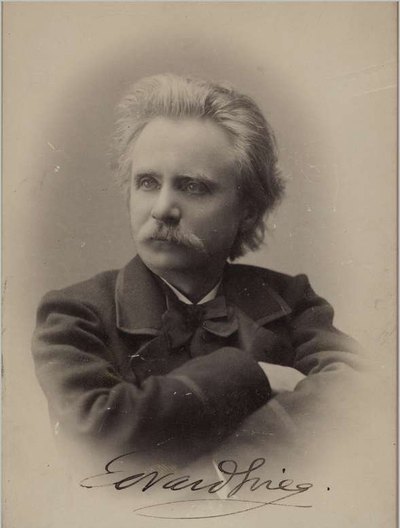 Edvard Grieg1843–1907 · born in Bergen, NorwayMore on Grieg →
For moods like
Anxious · Restless
fast · minor key · energy 5
Find more pieces in Listen by Mood →