Composers · Romantic
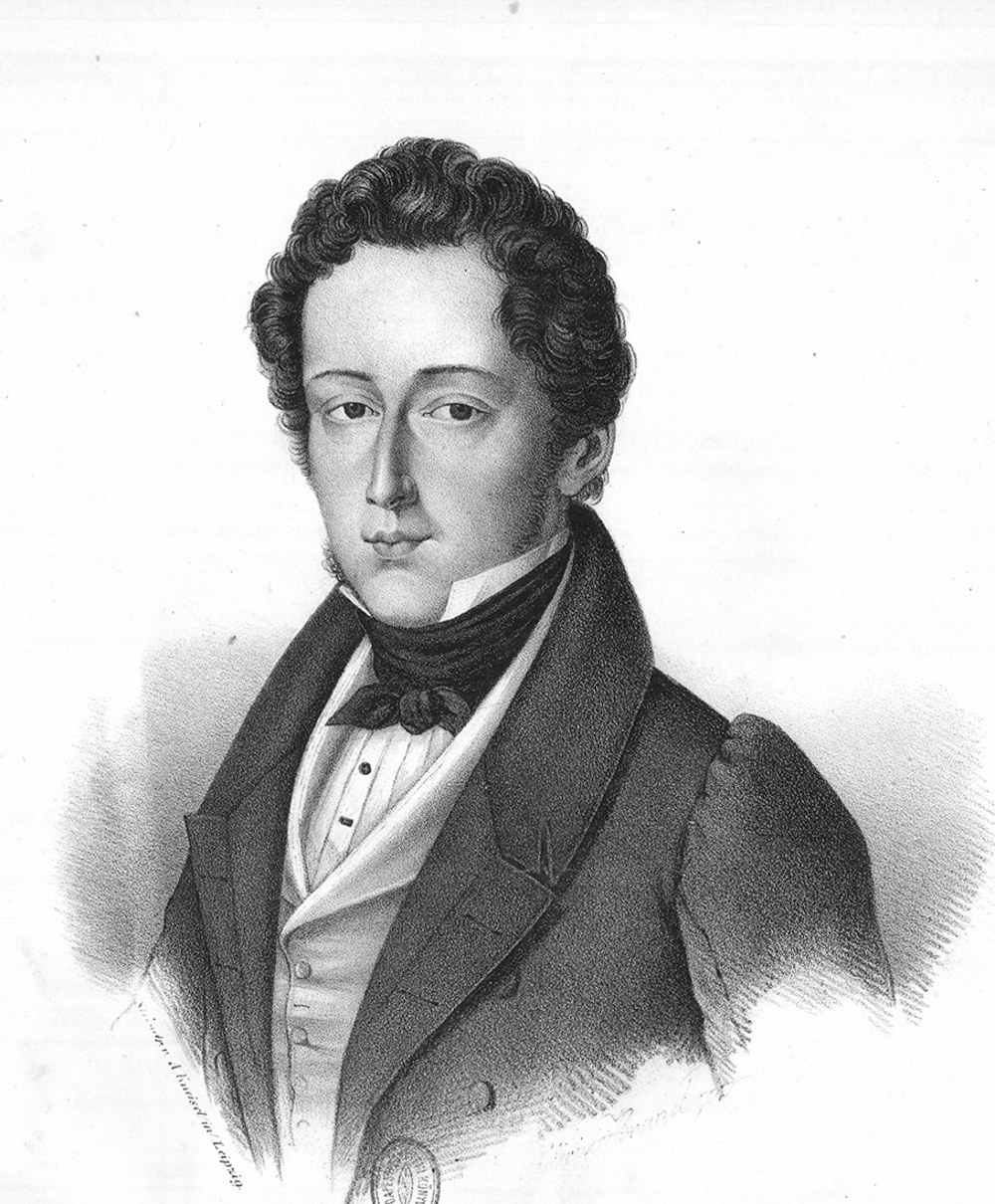
Frédéric Chopin
Fryderyk Chopin
- Life
- 1810–1849
- Born in
- Żelazowa Wola, Poland
- Era
- Romantic
The story of Chopin
November 1830. A twenty-year-old boards a coach leaving Warsaw. His friends, it is said, sang him a farewell song. Days later an uprising against Russia broke out at home, and he never set foot in Poland again. This is Frédéric Chopin.
The Warsaw prodigy
Chopin was born in 1810 at Żelazowa Wola near Warsaw. His father was an immigrant from France who taught French in Warsaw; his mother was Polish. Gifted at the piano from childhood, he published his first polonaise at seven and was hailed in aristocratic salons as "a second Mozart."
He studied at the Warsaw Conservatory with Józef Elsner, who recognized how unusual this pupil was and reportedly let him follow his own path rather than forcing him into a mold. Around twenty, Chopin wrote two piano concertos and played them himself in Warsaw.
The salons of Paris
Arriving in Paris via Vienna in autumn 1831, Chopin soon made his name among the city's musicians and aristocrats. He did not enjoy playing in large halls. Instead he played for small gatherings in salons and lived by teaching piano to aristocrats and the children of wealthy families. He was close to artists such as Liszt, Mendelssohn and Delacroix.
As a teacher, Chopin above all taught students to make the piano sing. His pupils recalled that he urged them to listen to Italian opera singers to learn how to breathe, and to bring out each finger's different character rather than forcing all the fingers to be the same.
He wrote almost nothing but piano music: nocturnes, mazurkas, polonaises, waltzes, études, preludes, ballades. In the mazurkas and polonaises, Polish dances, the rhythms of the homeland he had left live on.
George Sand
Around 1836 Chopin met the writer George Sand, who used a man's name as her pen name and wore trousers, among the most famous women writers of her day. They spent the winter of 1838 on the Mediterranean island of Majorca, where Chopin fell gravely ill. Afterwards he spent summers at Sand's country house at Nohant in France, writing many works there. Their relationship ended in 1847.
Last years
Chopin suffered for years from lung disease. In 1848, urged by his pupil Jane Stirling, he went to England and Scotland to perform, but grew weaker still. In October 1849 he died in Paris at thirty-nine. His body was buried in Paris, but as he had asked, his sister carried his heart home to Warsaw.
Music to hear on Pyeongeum
- Nocturne in E-flat, Op. 9 No. 2: the seventh stop on our Music Journey, a piano that sings like an opera aria.
- Ballade No. 1, the Fantaisie-Impromptu, the Prelude in E minor, the "Raindrop" Prelude, the "Minute" Waltz, the Étude Op. 10 No. 3, and the posthumous Nocturne in C-sharp minor.
People around him
- Józef Elsnerhis teacher at the Warsaw Conservatory, who did not block his pupil's path.
- George Sandthe writer who shared nearly ten years with him; summers at Nohant were vital composing time.
- His sister Ludwikawho stayed with him at the end and carried his heart home.
- Jane Stirlinga Scottish pupil and patron of his last years.
A question to think about
Chopin left home in an age when his country had lost its independence, lived in Paris, and made Poland's dances known to the world through the piano. His music is still a source of national pride for Poles. People who live far from home often keep their home culture alive.
Should the achievements of someone who left home be the pride of the country they left, or the country that took them in?
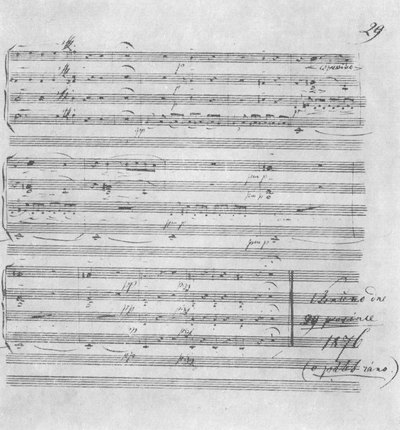
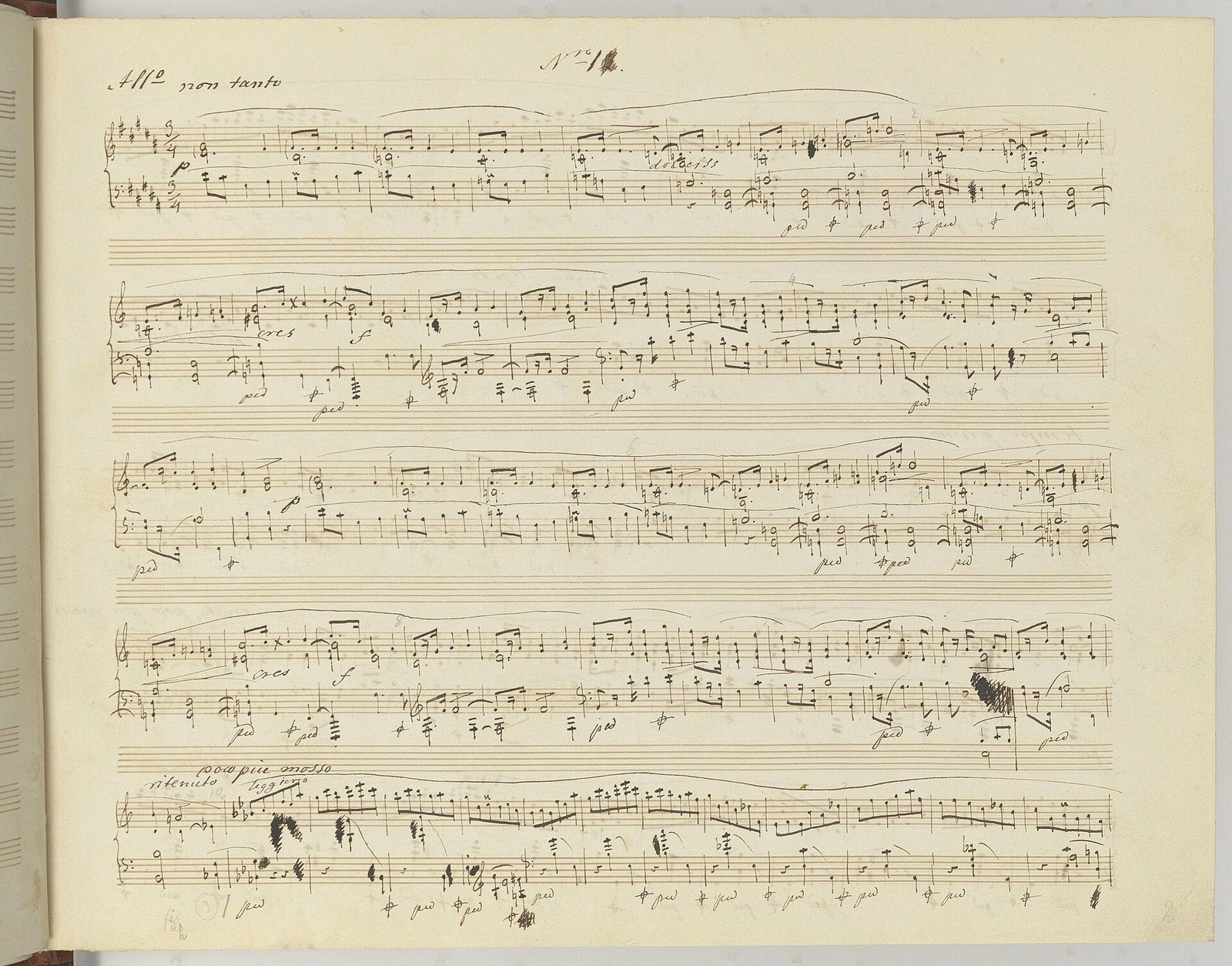
In the composer's own hand
Pieces along a life
Each dot is a piece on Pyeongeumjae — tap one to open it. The year is whichever is confirmed: composed, completed, published or premiered.
Pieces by Chopin
- Nocturne No. 2published 1832 · aged about 22 · about 5 minMusic Journey · track 7
- Ballade No. 1published 1836 · aged about 26 · about 9 min
- Fantaisie-Impromptupublished 1855 · aged about 45 · about 5 min
- Étude in C minorabout 3 min
- Mazurka No. 13about 5 min
- Mazurka No. 15about 3 min
- Mazurka No. 16about 3 min
- Polonaise in E-flat minorabout 8 min
- Polonaise in C minorabout 9 min
- Mazurka No. 8about 1 min
Hidden stories about Chopin
Composers of the same age
People whose lives overlapped with Chopin's by more than ten years