
Details
- Composer
- Frédéric Chopin
- When
- published 1836
- Catalogue no.
- Op. 23
- Key
- G minor
- Scoring
- Piano
- Length
- about 9 min
Recording
Morning music at 7
About this piece
There are no words, yet you hear a story, from a first sound like someone saying "once upon a time" to a breathless ending.
At a glance
- What it isthe first of Chopin's four ballades, in G minor, a long piano piece in a single movement.
- Who, when, whyChopin, settled in Paris, completed it around 1835 and published it in 1836. "Ballade" originally meant a song or poem that tells a story.
- What to listen forthe questioning chord of the slow opening, the swaying first theme, the warm second theme, and the stormy final section.
Listen for
- The openinga melody rises slowly from low down and stops on a hesitant chord, the moment just before a story begins.
- The two themesa lonely first theme that sways like a waltz, then a warmer, broader second theme. Both return transformed several times.
- The endinga very fast, fierce passage storms in, both hands racing over the keys, before decisive chords end the piece.
When it was written
In the mid-1830s Chopin was in his mid-twenties, gaining a name in the Paris salons and teaching piano, unable to return to Poland. Alongside small pieces like nocturnes and mazurkas, he now published, for the first time, a large, dramatic single-movement work like this.
Giving the name "ballade" to a piano piece rather than a song was a new idea. It is said the work was inspired by narrative poems of the Polish poet Mickiewicz, but Chopin himself left no record saying so. His friend Schumann is said to have loved this piece dearly.
A question to think about
Chopin never said what poem, if any, inspired this piece, yet people long to find the story behind it. We often feel we have truly understood a work only when we know the creator's life or intentions.
When appreciating a work, is it necessary to know what its maker intended? Is understanding it differently from that intention a legitimate way to appreciate it?
In the composer's life
published 1836 · Chopin, aged about 26
The composer
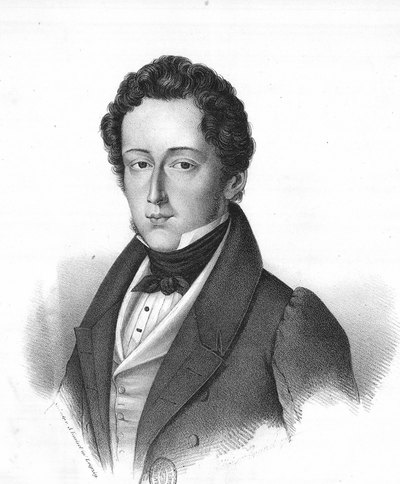 Frédéric Chopin1810–1849 · born in Żelazowa Wola, PolandMore on Chopin →
For moods like
Anxious · Stuck · Longing
moderate tempo · minor key · energy 4
Find more pieces in Listen by Mood →