
Details
- Composer
- Scott Joplin
- When
- published 1907
- Key
- B-flat major
- Scoring
- Piano
- Length
- about 3 min
Recording
Morning music at 7
About this piece
Picture a thick beam of light sweeping across the night sky. In 1907 Scott Joplin published a piano rag and called it Searchlight Rag. A searchlight is the powerful lamp that throws a beam far across the sky or the sea. Can sound draw a beam of light? While the left hand plants itself firmly on the ground, the right hand roams between the beats as if it were scanning the dark.
At a glance
- What it isa ragtime piece for piano in B-flat major. It takes about three minutes to hear from start to finish.
- Who and whenwritten by Scott Joplin and published in 1907, around the time he was moving to New York.
- What to listen forthe even step of the left hand, the right hand slipping off the beat, and the moments when a new section opens up.
Listen for
- The left hand's stepin a rag the left hand usually alternates a low bass note with a chord in the middle of the keyboard. That steady oom-pah is the floor the whole piece stands on.
- Right-hand syncopationsyncopation means putting the push just ahead of where the strong beat should land. Listen for places where the right-hand tune jumps out a step before the beat. It may feel like the beam suddenly swinging in a new direction.
- Where the sections change: rags are usually built like marches, from several short sections joined one after another. When a new section comes in, listen for whether the melody sits higher or lower, or sounds brighter or darker.
When it was written
Ragtime grew up among African American musicians in the late nineteenth century. This piano music, which laid syncopated rhythm over the frame of the march, sold widely as sheet music, and people sat down at the piano at home to try out the latest rags.
Joplin was born in Texas around 1868. His father, a former slave, worked as a railroad laborer. As a young man Joplin travelled the Midwest playing piano, and in the 1890s he settled in Sedalia, Missouri. He made his name in 1899 with the Maple Leaf Rag, and in 1902 he published The Entertainer.
Around 1907, the year this piece appeared, Joplin moved to New York. The following year, 1908, he published School of Ragtime, a set of exercises on how to play the music. On a number of his scores he also printed a warning not to play ragtime fast. So it is worth hearing this piece at an unhurried walk, too.
Scott Joplin, the composer
Joplin's ambitions reached well beyond a single rag. In 1911 he paid to publish the score of his opera Treemonisha, but he never saw a proper staging of it in his lifetime. By the time he died in New York in 1917, popular taste was already moving toward jazz. His music became widely known again through the 1973 film The Sting, and in 1976 he was awarded a special Pulitzer Prize.
A question to think about
Joplin published Searchlight Rag in 1907, and he was the kind of musician who told players not to rush ragtime. Yet the opera that carried his biggest hopes never reached the stage properly while he lived, and his music only stepped back into the light more than half a century after his death.
People and their work still go unnoticed in their own time today. If we want to recognise the talents around us that no searchlight has found yet, what could we start doing differently?
The composer
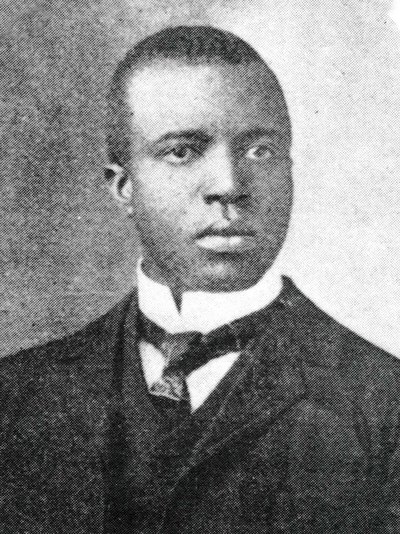 Scott Joplinc. 1868–1917More on Joplin →
For moods like
Grateful · Calm · Focused
moderate tempo · major key · energy 3
Find more pieces in Listen by Mood →More by Joplin
- Combination Marchpublished 1896 · about 3 min
- Harmony Club Waltzpublished 1896 · about 6 min
- Maple Leaf Ragpublished 1899 · about 3 min
- Original Ragspublished 1899 · about 4 min
- Swipesy Cakewalkpublished 1900 · about 3 min
- Augustan Club Waltzpublished 1901 · about 4 min
- Peacherine Ragpublished 1901 · about 3 min
- Sunflower Slow Dragpublished 1901 · about 3 min
- A Breeze from Alabamapublished 1902 · about 4 min
- Cleophapublished 1902 · about 3 min
- Elite Syncopationspublished 1902 · about 3 min
- March Majesticpublished 1902 · about 3 min
- The Entertainerpublished 1902 · about 4 min
- Palm Leaf Ragpublished 1903 · about 4 min
- Something Doingpublished 1903 · about 3 min
- Weeping Willowpublished 1903 · about 3 min
- The Favoritepublished 1904 · about 3 min
- The Sycamorepublished 1904 · about 3 min
- Eugeniapublished 1905 · about 4 min
- Leolapublished 1905 · about 5 min
- The Rose-bud Marchpublished 1905 · about 3 min
- Antoinettepublished 1906 · about 3 min
- Gladiolus Ragpublished 1907 · about 3 min
- Heliotrope Bouquetpublished 1907 · about 3 min
- Lily Queenpublished 1907 · about 3 min
- Rose Leaf Ragpublished 1907 · about 4 min
- The Nonpareilpublished 1907 · about 3 min
- Fig Leaf Ragpublished 1908 · about 4 min
- Pine Apple Ragpublished 1908 · about 3 min
- Sugar Canepublished 1908 · about 3 min
- Euphonic Soundspublished 1909 · about 3 min
- Paragon Ragpublished 1909 · about 3 min
- Pleasant Momentspublished 1909 · about 3 min
- Felicity Ragpublished 1911 · about 3 min
- Magnetic Ragpublished 1914 · about 4 min
- Silver Swan Ragpublished 1914 · about 3 min
- Reflection Ragpublished 1917 · about 4 min