
Details
- Composer
- Scott Joplin
- When
- published 1905
- Key
- G major
- Scoring
- Piano
- Length
- about 3 min
Recording
Morning music at 7
Track info
「The Rose-bud March」Performed by Gnissahrecorded 2024Wikimedia CommonsPublic Domain
About this piece
Scott Joplin is famous for ragtime, so why did he put the word 'march' on a piece? A rag gets its lilt by slipping just off the beat, while a march wants everyone in step. In fact, ragtime grew out of the march. The Rose-bud March lets us meet that root again in Joplin's own hands.
At a glance
- What it isa march for solo piano, in G major.
- Who and whenwritten by Scott Joplin and published in 1905.
- What to listen forthe even, marching stride, and where this piece is like a rag and where it is not.
Listen for
- The left hand's stridein a piano march the left hand usually alternates a low note and a chord, stepping 'one, two'. It sounds very close to the left hand of a rag. Notice whether that step stays steady all the way through.
- The right-hand tunea rag's right hand gets its lilt from syncopation, rhythm that deliberately pushes ahead of or holds back from the beat. A march tune usually moves more squarely on the beat. Listen for which side this right hand leans toward.
- When a new section arrives: marches are usually built from several sections, and later on there is often a contrasting part called the trio. Listen for how the height and weight of the music change as each new section comes in.
When it was written
In late nineteenth-century America, marches played by brass bands were hugely popular, and people bought march sheet music to play on the piano at home. Ragtime took the frame of the march, the evenly striding left hand and the chain of sections, and laid syncopated rhythm on top of it.
Joplin did not write only rags. He also wrote marches and waltzes, and in 1908 he published School of Ragtime, a set of exercises on how to play it. In the early 1900s he was based in St. Louis, and around 1907 he moved to New York.
The composer Scott Joplin
Joplin was born in Texas around 1868. His father, who had been born into slavery, worked on the railroad, and his mother did domestic work. As a boy he is said to have been taught for free by a music teacher named Julius Weiss. He made his name in 1899 with the Maple Leaf Rag, but his opera Treemonisha, which he published at his own expense in 1911, never received a proper staging in his lifetime. He died in New York in 1917.
A question to think about
Even after making his name with off-beat music, Joplin published a piece he called a march, the kind of music meant for walking in step. If we listen while remembering that ragtime grew out of the march's frame, this piece lets us trace the rag back to its roots.
For someone making something new, is a familiar form a fence that holds them back, or a springboard to leap from? What forms like that shape your own work or study, and how do you use them?
The composer
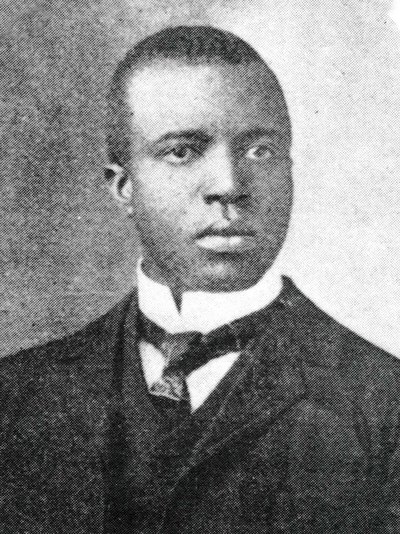 Scott Joplinc. 1868–1917More on Joplin →
For moods like
Grateful · Calm · Focused
moderate tempo · major key · energy 3
Find more pieces in Listen by Mood →More by Joplin
- Combination Marchpublished 1896 · about 3 min
- Harmony Club Waltzpublished 1896 · about 6 min
- Maple Leaf Ragpublished 1899 · about 3 min
- Original Ragspublished 1899 · about 4 min
- Swipesy Cakewalkpublished 1900 · about 3 min
- Augustan Club Waltzpublished 1901 · about 4 min
- Peacherine Ragpublished 1901 · about 3 min
- Sunflower Slow Dragpublished 1901 · about 3 min
- A Breeze from Alabamapublished 1902 · about 4 min
- Cleophapublished 1902 · about 3 min
- Elite Syncopationspublished 1902 · about 3 min
- March Majesticpublished 1902 · about 3 min
- The Entertainerpublished 1902 · about 4 min
- Palm Leaf Ragpublished 1903 · about 4 min
- Something Doingpublished 1903 · about 3 min
- Weeping Willowpublished 1903 · about 3 min
- The Favoritepublished 1904 · about 3 min
- The Sycamorepublished 1904 · about 3 min
- Eugeniapublished 1905 · about 4 min
- Leolapublished 1905 · about 5 min
- Antoinettepublished 1906 · about 3 min
- Gladiolus Ragpublished 1907 · about 3 min
- Heliotrope Bouquetpublished 1907 · about 3 min
- Lily Queenpublished 1907 · about 3 min
- Rose Leaf Ragpublished 1907 · about 4 min
- Searchlight Ragpublished 1907 · about 3 min
- The Nonpareilpublished 1907 · about 3 min
- Fig Leaf Ragpublished 1908 · about 4 min
- Pine Apple Ragpublished 1908 · about 3 min
- Sugar Canepublished 1908 · about 3 min
- Euphonic Soundspublished 1909 · about 3 min
- Paragon Ragpublished 1909 · about 3 min
- Pleasant Momentspublished 1909 · about 3 min
- Felicity Ragpublished 1911 · about 3 min
- Magnetic Ragpublished 1914 · about 4 min
- Silver Swan Ragpublished 1914 · about 3 min
- Reflection Ragpublished 1917 · about 4 min