
Details
- Composer
- Scott Joplin
- When
- published 1900
- Key
- B-flat major
- Scoring
- Piano
- Length
- about 3 min
Recording
Morning music at 7
Track info
「Swipesy Cakewalk」Performed by Gnissahrecorded 2024Wikimedia CommonsPublic Domain
About this piece
In 1900 a sheet of ragtime music came out with two names printed side by side: Scott Joplin and Arthur Marshall. The piece was called Swipesy Cakewalk. A cakewalk was a dance, so why does a dance give its name to a rag? And why did Joplin, who was already writing fine rags on his own, share this one with someone else?
At a glance
- What it isa ragtime piece for piano in B-flat major, about three minutes long.
- Who and whenwritten by Scott Joplin together with Arthur Marshall, and published by John Stark in 1900.
- What to listen fora right hand that bounces as if dancing, over a left hand that keeps the step.
Listen for
- The left hand's stepin a rag the left hand usually alternates a low note and a chord, walking evenly in two. Like a dancer's feet, it lays down a floor that never wobbles.
- The right hand's syncopation: syncopation is rhythm that deliberately sidesteps the strong beat. Notice the moments when the right hand jumps just ahead of the beat, and see whether you start to sway.
- When the section changes: rags are usually built from several short sections that follow one another. Listen for how the height of the melody and the mood shift when a new section begins.
When it was written
The cakewalk is generally traced to a dance performed by enslaved Black people on plantations in the American South. Couples strutted with straight backs and showy steps, and the dance is said to have gently mocked the stiff ballroom manners of white landowners. The name is said to come from contests where the prize was a cake. In the 1890s the cakewalk became a craze on stage and in dance halls.
Joplin worked in Sedalia, Missouri, in the 1890s, and made his name in 1899 with the Maple Leaf Rag, published by John Stark. This piece followed the very next year. Arthur Marshall, whose name appears with his, was a young musician who studied with Joplin in Sedalia.
The composer, Scott Joplin
Joplin was born in Texas around 1868. His father had been enslaved and later worked on the railroad; his mother kept the family going with domestic work. Joplin treated ragtime as serious music, and in 1908 he published School of Ragtime, a guide to playing it. He died in New York in 1917. His music found a wide audience again after it was used in the 1973 film The Sting, and in 1976 he received a special Pulitzer award.
A question to think about
The cakewalk is said to have begun as a dance in which people with little power shared a laugh by imitating the manners of those who held power over them. It later became a fashion on the stage, and Joplin and Marshall put its name on this rag.
When the games or culture of one group spread to outsiders as a passing fashion, what happens to the meaning they first carried? How can we enjoy something like this while still remembering where it came from?
The composer
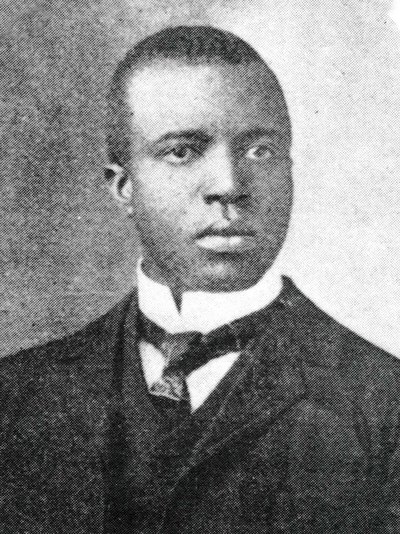 Scott Joplinc. 1868–1917More on Joplin →
For moods like
Excited · Joyful
fast · major key · energy 4
Find more pieces in Listen by Mood →More by Joplin
- Combination Marchpublished 1896 · about 3 min
- Harmony Club Waltzpublished 1896 · about 6 min
- Maple Leaf Ragpublished 1899 · about 3 min
- Original Ragspublished 1899 · about 4 min
- Augustan Club Waltzpublished 1901 · about 4 min
- Peacherine Ragpublished 1901 · about 3 min
- Sunflower Slow Dragpublished 1901 · about 3 min
- A Breeze from Alabamapublished 1902 · about 4 min
- Cleophapublished 1902 · about 3 min
- Elite Syncopationspublished 1902 · about 3 min
- March Majesticpublished 1902 · about 3 min
- The Entertainerpublished 1902 · about 4 min
- Palm Leaf Ragpublished 1903 · about 4 min
- Something Doingpublished 1903 · about 3 min
- Weeping Willowpublished 1903 · about 3 min
- The Favoritepublished 1904 · about 3 min
- The Sycamorepublished 1904 · about 3 min
- Eugeniapublished 1905 · about 4 min
- Leolapublished 1905 · about 5 min
- The Rose-bud Marchpublished 1905 · about 3 min
- Antoinettepublished 1906 · about 3 min
- Gladiolus Ragpublished 1907 · about 3 min
- Heliotrope Bouquetpublished 1907 · about 3 min
- Lily Queenpublished 1907 · about 3 min
- Rose Leaf Ragpublished 1907 · about 4 min
- Searchlight Ragpublished 1907 · about 3 min
- The Nonpareilpublished 1907 · about 3 min
- Fig Leaf Ragpublished 1908 · about 4 min
- Pine Apple Ragpublished 1908 · about 3 min
- Sugar Canepublished 1908 · about 3 min
- Euphonic Soundspublished 1909 · about 3 min
- Paragon Ragpublished 1909 · about 3 min
- Pleasant Momentspublished 1909 · about 3 min
- Felicity Ragpublished 1911 · about 3 min
- Magnetic Ragpublished 1914 · about 4 min
- Silver Swan Ragpublished 1914 · about 3 min
- Reflection Ragpublished 1917 · about 4 min