
Details
- Composer
- Scott Joplin
- When
- published 1902
- Key
- F major
- Scoring
- Piano
- Length
- about 3 min
Recording
Morning music at 7
Track info
「Cleopha」Performed by Gnissahrecorded 2024Wikimedia CommonsPublic Domain
About this piece
Cleopha: a short title that sounds like someone's name. When the piano starts, the left hand walks briskly while the right hand hops lightly in between its steps. It comes from 1902, when Scott Joplin was publishing several pieces one after another in a single year.
At a glance
- What it isa piano piece in the ragtime style.
- Who and whenwritten by Scott Joplin and published in 1902, the same year as The Entertainer.
- What to listen forthe even, march-like step of the left hand, and the bouncing rhythm of the right hand above it.
Listen for
- March rootsragtime grew out of the frame of the march. Listen for whether you hear a band's footsteps as the left hand walks, alternating low notes and chords.
- Right-hand syncopationin a classic rag the right hand usually creates its lilt with syncopation, deliberately striking ahead of the beat. Tap the beat with your foot as you listen and you will feel more clearly when the right hand slips off it.
- Several sectionsclassic rags are usually built from several sections of around sixteen bars that follow one another and repeat. Follow along to hear whether a melody you heard earlier comes back or the music moves on to a new one.
When it was written
In the 1890s marches were hugely popular in America, and people danced a dance called the two-step to their beat. At the same time ragtime, which grew up among African American musicians, laid syncopated rhythm over the frame of the march and became music good both for dancing and for playing at home. With no radio, new music spread mainly as sheet music.
After making his name in 1899 with the Maple Leaf Rag, Joplin moved to St. Louis around 1901 and devoted himself to composing. In 1902, the year Cleopha came out, he also published The Entertainer. In 1908 he published an instruction book on how to play ragtime, urging that rags should not be played fast.
Joplin died in New York in 1917, and his music came to be widely loved again in the 1970s.
A question to think about
The title Cleopha sounds like a person's name, but we could not confirm the story behind that name, so we have left it out here. Over more than a hundred years, the piece has stayed while its story has faded.
How does music sound different when you hear it without knowing the story behind its title, and when you know it? Among the songs you love, which one makes you curious about its story?
The composer
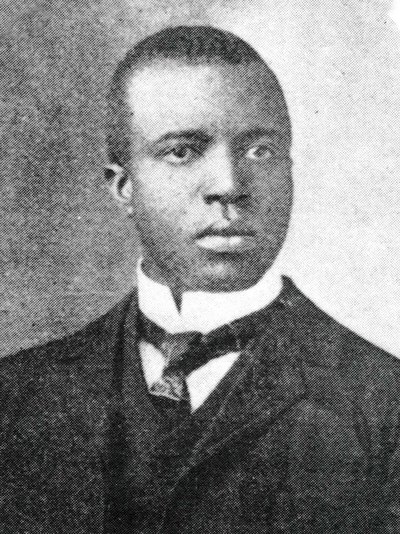 Scott Joplinc. 1868–1917More on Joplin →
For moods like
Excited · Joyful
fast · major key · energy 4
Find more pieces in Listen by Mood →More by Joplin
- Combination Marchpublished 1896 · about 3 min
- Harmony Club Waltzpublished 1896 · about 6 min
- Maple Leaf Ragpublished 1899 · about 3 min
- Original Ragspublished 1899 · about 4 min
- Swipesy Cakewalkpublished 1900 · about 3 min
- Augustan Club Waltzpublished 1901 · about 4 min
- Peacherine Ragpublished 1901 · about 3 min
- Sunflower Slow Dragpublished 1901 · about 3 min
- A Breeze from Alabamapublished 1902 · about 4 min
- Elite Syncopationspublished 1902 · about 3 min
- March Majesticpublished 1902 · about 3 min
- The Entertainerpublished 1902 · about 4 min
- Palm Leaf Ragpublished 1903 · about 4 min
- Something Doingpublished 1903 · about 3 min
- Weeping Willowpublished 1903 · about 3 min
- The Favoritepublished 1904 · about 3 min
- The Sycamorepublished 1904 · about 3 min
- Eugeniapublished 1905 · about 4 min
- Leolapublished 1905 · about 5 min
- The Rose-bud Marchpublished 1905 · about 3 min
- Antoinettepublished 1906 · about 3 min
- Gladiolus Ragpublished 1907 · about 3 min
- Heliotrope Bouquetpublished 1907 · about 3 min
- Lily Queenpublished 1907 · about 3 min
- Rose Leaf Ragpublished 1907 · about 4 min
- Searchlight Ragpublished 1907 · about 3 min
- The Nonpareilpublished 1907 · about 3 min
- Fig Leaf Ragpublished 1908 · about 4 min
- Pine Apple Ragpublished 1908 · about 3 min
- Sugar Canepublished 1908 · about 3 min
- Euphonic Soundspublished 1909 · about 3 min
- Paragon Ragpublished 1909 · about 3 min
- Pleasant Momentspublished 1909 · about 3 min
- Felicity Ragpublished 1911 · about 3 min
- Magnetic Ragpublished 1914 · about 4 min
- Silver Swan Ragpublished 1914 · about 3 min
- Reflection Ragpublished 1917 · about 4 min