
Details
- Composer
- Scott Joplin
- When
- published 1907
- Key
- G major
- Scoring
- Piano
- Length
- about 3 min
Recording
Morning music at 7
Track info
「Heliotrope Bouquet」Performed by Gnissahrecorded 2024Wikimedia CommonsPublic Domain
About this piece
Two names appear on the cover of the sheet music: Scott Joplin and Louis Chauvin. Joplin was already known for the Maple Leaf Rag, so why did he share the credit with another pianist? Heliotrope Bouquet came out in 1907. Heliotrope is a plant with clusters of small purple flowers and a sweet fragrance, so the title means a bunch of heliotrope blossoms. Think of the piece as a bouquet the two men tied together and handed to us.
At a glance
- What it isa ragtime piece for piano. The sheet music gives it the subtitle 'A Slow Drag Two-Step'.
- Who and whenpublished in 1907 under the names of Scott Joplin and Louis Chauvin.
- What to listen forthe easy, dragging step, the right hand slipping just off the beat above it, and the bright sound of G major.
Listen for
- A slow stepa 'slow drag' is a dance done slowly, the feet almost sliding along the floor. Compared with a bouncy, quick rag, listen for how the melody breathes inside this more relaxed step.
- Left hand and right hand: in a rag the left hand usually alternates a low note and a chord, walking evenly. The right hand creates its lilt with syncopation, pushing ahead of the beat or holding back from it. Listen for how gently those off-beats land here.
- When a section changesclassic rags are usually built from several sections that follow one another and repeat. Listen for how the mood shifts each time a new section comes in.
When it was written
Ragtime is piano music that grew up among African American musicians in the late nineteenth century. It laid syncopated rhythm over the frame of the march and sold widely as sheet music. There was no radio yet, so people bought the sheet music and tried out new rags on the piano at home.
In the 1890s Joplin worked in Sedalia, and afterward he moved to St. Louis. Around 1907, about the time this piece appeared, he moved on to New York. The following year, 1908, he published School of Ragtime, a short guide to playing rags.
Louis Chauvin, the other name
Chauvin was a young pianist who worked in St. Louis and was known for his playing. He left very few pieces in written form, though, and Heliotrope Bouquet is one of that handful. He died in 1908, the year after it was published, before reaching thirty.
Joplin died in New York in 1917. His music was largely forgotten for a time, then won a wide audience again when his pieces were used in the 1973 film The Sting.
A question to think about
The sheet music for this piece carries two names, Joplin's and Chauvin's. Chauvin was known as a player, but he left very little music on paper. We can hear his music today largely because of the few pieces, like this one, that made it into print.
Today, too, a great deal of work passes through many hands before it is finished, yet the credit often ends up with just one person. When people make something together, what should we go by to call the sharing of credit fair?
The composer
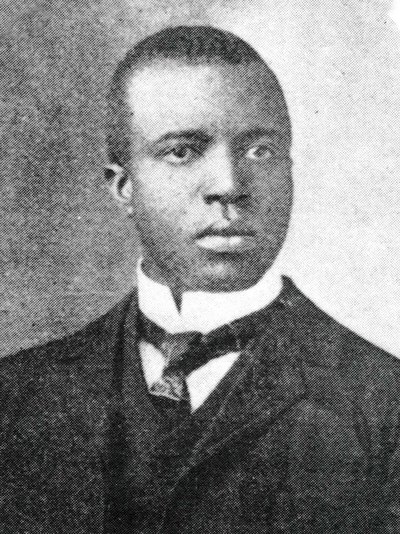 Scott Joplinc. 1868–1917More on Joplin →
For moods like
Excited · Joyful
fast · major key · energy 4
Find more pieces in Listen by Mood →More by Joplin
- Combination Marchpublished 1896 · about 3 min
- Harmony Club Waltzpublished 1896 · about 6 min
- Maple Leaf Ragpublished 1899 · about 3 min
- Original Ragspublished 1899 · about 4 min
- Swipesy Cakewalkpublished 1900 · about 3 min
- Augustan Club Waltzpublished 1901 · about 4 min
- Peacherine Ragpublished 1901 · about 3 min
- Sunflower Slow Dragpublished 1901 · about 3 min
- A Breeze from Alabamapublished 1902 · about 4 min
- Cleophapublished 1902 · about 3 min
- Elite Syncopationspublished 1902 · about 3 min
- March Majesticpublished 1902 · about 3 min
- The Entertainerpublished 1902 · about 4 min
- Palm Leaf Ragpublished 1903 · about 4 min
- Something Doingpublished 1903 · about 3 min
- Weeping Willowpublished 1903 · about 3 min
- The Favoritepublished 1904 · about 3 min
- The Sycamorepublished 1904 · about 3 min
- Eugeniapublished 1905 · about 4 min
- Leolapublished 1905 · about 5 min
- The Rose-bud Marchpublished 1905 · about 3 min
- Antoinettepublished 1906 · about 3 min
- Gladiolus Ragpublished 1907 · about 3 min
- Lily Queenpublished 1907 · about 3 min
- Rose Leaf Ragpublished 1907 · about 4 min
- Searchlight Ragpublished 1907 · about 3 min
- The Nonpareilpublished 1907 · about 3 min
- Fig Leaf Ragpublished 1908 · about 4 min
- Pine Apple Ragpublished 1908 · about 3 min
- Sugar Canepublished 1908 · about 3 min
- Euphonic Soundspublished 1909 · about 3 min
- Paragon Ragpublished 1909 · about 3 min
- Pleasant Momentspublished 1909 · about 3 min
- Felicity Ragpublished 1911 · about 3 min
- Magnetic Ragpublished 1914 · about 4 min
- Silver Swan Ragpublished 1914 · about 3 min
- Reflection Ragpublished 1917 · about 4 min