
Details
- Composer
- Scott Joplin
- When
- published 1903
- Key
- B-flat major
- Scoring
- Piano
- Length
- about 4 min
Recording
Morning music at 7
About this piece
Picture a palm leaf: wide, fanned out, swaying slowly in warm air. In 1903 Scott Joplin gave one of his rags the name Palm Leaf Rag. Four years earlier, the piece that made his name had also carried a leaf in its title, the maple. From one leaf to another, what kind of step would Joplin's piano take this time?
At a glance
- What it isa ragtime piece for solo piano, in B-flat major.
- Who and whenwritten by Scott Joplin and published in 1903.
- What to listen forthe steady walk of the left hand, the right hand slipping off the beat, and the moment each new section begins.
Listen for
- The walking left handin a rag the left hand usually alternates a low bass note with a chord in the middle of the keyboard. Oom, pah, oom, pah. The playfulness up top only works if this step stays steady.
- The slipping right handthe right hand dodges the place where a strong beat should land, coming in a little early or a little late. This is called syncopation. Notice where your foot starts tapping on its own.
- The changing sectionsrags are usually built like marches, from several short sections that follow one another and repeat. When a new tune arrives, listen for whether the mood brightens or settles down.
When it was written
Around this time Joplin was living in St. Louis. The Maple Leaf Rag, published in 1899, had sold widely as sheet music and made him known, and in 1902 he published The Entertainer. Ragtime grew up among African American musicians in the late nineteenth century and became a huge craze in sheet music.
Joplin is known for urging players not to play ragtime fast. In 1908 he even put out a book of exercises on how to play it, School of Ragtime. For him a rag was not something to rush through for a quick thrill, but music to be played with care.
Scott Joplin
Joplin was born in Texas around 1868. His father, who had been enslaved, worked on the railroad, and his mother did domestic work to help support the family. As a young man he wandered the Midwest playing piano, and in the 1890s he spent time in Sedalia, Missouri.
Even after ragtime made his name, he reached for something bigger. In 1911 he published his opera Treemonisha at his own expense, but he never saw a proper performance of it in his lifetime. Joplin died in New York in 1917, and only in 1976 was he given a special Pulitzer Prize.
A question to think about
By the time he published Palm Leaf Rag, Joplin was already a well-known composer of rags. Even so, he went on to write an opera, and Treemonisha was only properly staged in the 1970s, long after his death.
Some work finds few people to recognise it while its maker is alive, and only shines after many years have passed. If there is good work around us today that we have not yet noticed, whose job is it to be the first to recognise it and care for it?
The composer
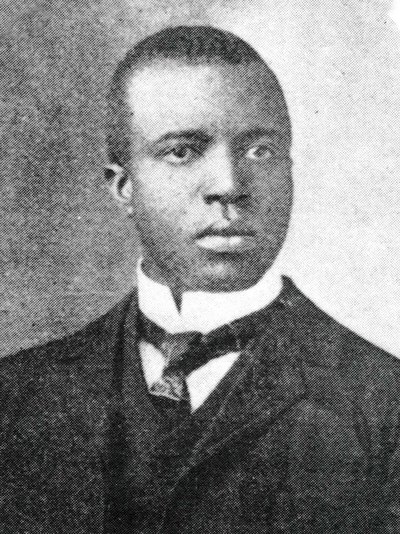 Scott Joplinc. 1868–1917More on Joplin →
For moods like
Grateful · Calm · Focused
moderate tempo · major key · energy 3
Find more pieces in Listen by Mood →More by Joplin
- Combination Marchpublished 1896 · about 3 min
- Harmony Club Waltzpublished 1896 · about 6 min
- Maple Leaf Ragpublished 1899 · about 3 min
- Original Ragspublished 1899 · about 4 min
- Swipesy Cakewalkpublished 1900 · about 3 min
- Augustan Club Waltzpublished 1901 · about 4 min
- Peacherine Ragpublished 1901 · about 3 min
- Sunflower Slow Dragpublished 1901 · about 3 min
- A Breeze from Alabamapublished 1902 · about 4 min
- Cleophapublished 1902 · about 3 min
- Elite Syncopationspublished 1902 · about 3 min
- March Majesticpublished 1902 · about 3 min
- The Entertainerpublished 1902 · about 4 min
- Something Doingpublished 1903 · about 3 min
- Weeping Willowpublished 1903 · about 3 min
- The Favoritepublished 1904 · about 3 min
- The Sycamorepublished 1904 · about 3 min
- Eugeniapublished 1905 · about 4 min
- Leolapublished 1905 · about 5 min
- The Rose-bud Marchpublished 1905 · about 3 min
- Antoinettepublished 1906 · about 3 min
- Gladiolus Ragpublished 1907 · about 3 min
- Heliotrope Bouquetpublished 1907 · about 3 min
- Lily Queenpublished 1907 · about 3 min
- Rose Leaf Ragpublished 1907 · about 4 min
- Searchlight Ragpublished 1907 · about 3 min
- The Nonpareilpublished 1907 · about 3 min
- Fig Leaf Ragpublished 1908 · about 4 min
- Pine Apple Ragpublished 1908 · about 3 min
- Sugar Canepublished 1908 · about 3 min
- Euphonic Soundspublished 1909 · about 3 min
- Paragon Ragpublished 1909 · about 3 min
- Pleasant Momentspublished 1909 · about 3 min
- Felicity Ragpublished 1911 · about 3 min
- Magnetic Ragpublished 1914 · about 4 min
- Silver Swan Ragpublished 1914 · about 3 min
- Reflection Ragpublished 1917 · about 4 min