
Details
- Composer
- Scott Joplin
- When
- published 1901
- Key
- B-flat major
- Scoring
- Piano
- Length
- about 3 min
Recording
Morning music at 7
Track info
「Sunflower Slow Drag」Performed by Gnissahrecorded 2024Wikimedia CommonsPublic Domain
About this piece
Sunflowers are said to turn slowly to follow the sun. But next to the sunflower, this title carries an odd phrase: slow drag. Does it mean dragging something along, or something else entirely? The sheet music for this rag, published in 1901, carries two names: Scott Joplin, and a young musician named Scott Hayden. What kind of step did the two of them make together?
At a glance
- What it isa ragtime piece for solo piano, in B-flat major.
- Who and whenwritten by Scott Joplin and Scott Hayden together, and published in 1901.
- What to listen foran unhurried step, a right hand that slips just off the beat above it, and the moments when a new section begins.
Listen for
- A slow stepslow drag was the name of a slow dance. Since the piece is named after a dance, try listening while picturing bodies swaying gently in time.
- Two hands in conversation: in ragtime the left hand usually moves between low notes and chords to hold the beat steady, while the right hand adds lift with syncopation. Syncopation is rhythm that arrives a little before or after the place where the strong beat should fall. Listen for spots where the hands pull apart and then lock together again.
- When the section changes: a classic rag is usually built from several short sections strung together and repeated. When a new one arrives, notice how the height of the tune or its mood shifts.
When it was written
In the 1890s Joplin was living and playing piano in Sedalia, a small town in Missouri. When the Maple Leaf Rag came out in 1899, his name spread widely. There was no radio yet, so people bought rags as sheet music and played them on the piano at home. That is how ragtime travelled across America, one printed page at a time.
Scott Hayden was a young musician in Sedalia who studied with Joplin and was close to him. Sunflower Slow Drag is one of the rags the two wrote together. Around 1901 Joplin made his home in St. Louis, and the following year he published The Entertainer.
The slow drag comes back
About ten years later Joplin wrote an opera, Treemonisha, and published it at his own expense in 1911. The opera ends with a number called A Real Slow Drag. The step of that slow dance, it seems, stayed with him for a long time. Joplin never saw the opera properly staged in his lifetime, and he died in New York in 1917. His music found a wide audience again in the 1970s, thanks to the film The Sting.
A question to think about
The sheet music of this piece carries two names, Joplin and Hayden. Today it is usually listed among Joplin's works, yet from the very start it was something the two of them made together.
When a work made by several people comes to be remembered as belonging to the most famous one among them, how should the share of the others be remembered? And in the things you have made together with someone else, how has that worked out?
The composer
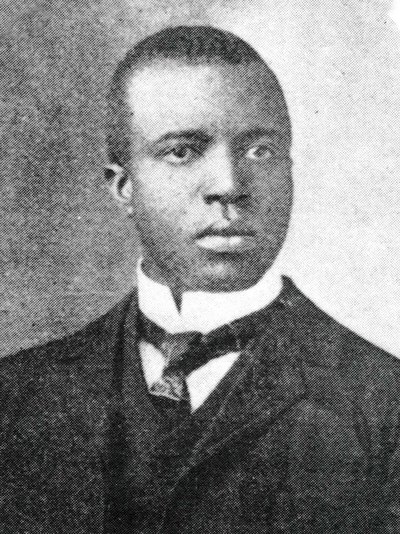 Scott Joplinc. 1868–1917More on Joplin →
For moods like
Excited · Joyful
fast · major key · energy 4
Find more pieces in Listen by Mood →More by Joplin
- Combination Marchpublished 1896 · about 3 min
- Harmony Club Waltzpublished 1896 · about 6 min
- Maple Leaf Ragpublished 1899 · about 3 min
- Original Ragspublished 1899 · about 4 min
- Swipesy Cakewalkpublished 1900 · about 3 min
- Augustan Club Waltzpublished 1901 · about 4 min
- Peacherine Ragpublished 1901 · about 3 min
- A Breeze from Alabamapublished 1902 · about 4 min
- Cleophapublished 1902 · about 3 min
- Elite Syncopationspublished 1902 · about 3 min
- March Majesticpublished 1902 · about 3 min
- The Entertainerpublished 1902 · about 4 min
- Palm Leaf Ragpublished 1903 · about 4 min
- Something Doingpublished 1903 · about 3 min
- Weeping Willowpublished 1903 · about 3 min
- The Favoritepublished 1904 · about 3 min
- The Sycamorepublished 1904 · about 3 min
- Eugeniapublished 1905 · about 4 min
- Leolapublished 1905 · about 5 min
- The Rose-bud Marchpublished 1905 · about 3 min
- Antoinettepublished 1906 · about 3 min
- Gladiolus Ragpublished 1907 · about 3 min
- Heliotrope Bouquetpublished 1907 · about 3 min
- Lily Queenpublished 1907 · about 3 min
- Rose Leaf Ragpublished 1907 · about 4 min
- Searchlight Ragpublished 1907 · about 3 min
- The Nonpareilpublished 1907 · about 3 min
- Fig Leaf Ragpublished 1908 · about 4 min
- Pine Apple Ragpublished 1908 · about 3 min
- Sugar Canepublished 1908 · about 3 min
- Euphonic Soundspublished 1909 · about 3 min
- Paragon Ragpublished 1909 · about 3 min
- Pleasant Momentspublished 1909 · about 3 min
- Felicity Ragpublished 1911 · about 3 min
- Magnetic Ragpublished 1914 · about 4 min
- Silver Swan Ragpublished 1914 · about 3 min
- Reflection Ragpublished 1917 · about 4 min