Composers · Romantic
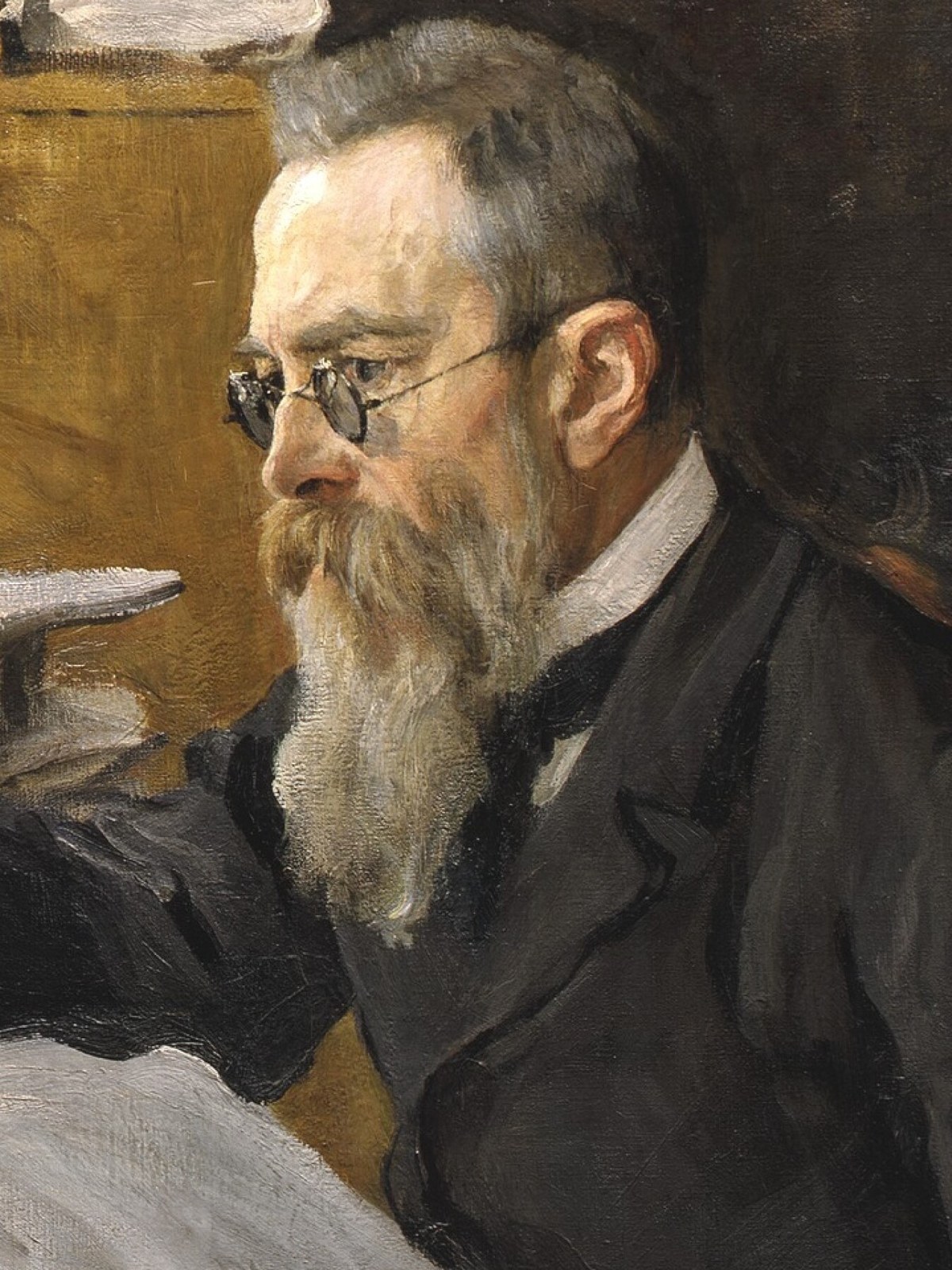
Nikolai Rimsky-Korsakov
Nikolai Rimsky-Korsakov
- Life
- 1844–1908
- Born in
- Tikhvin, Russia
- Era
- Romantic
The story of Rimsky-Korsakov
1862. An eighteen-year-old naval cadet boards a Russian warship for a long voyage via England, America and Brazil, spending nearly three years at sea. On board, in spare moments, he was writing his first symphony. This is Nikolai Rimsky-Korsakov.
A boy from a naval family
Rimsky-Korsakov was born in 1844 in Tikhvin, a small town in northwest Russia, into a family full of naval officers; his brother was in the navy too. As a boy he learned piano and loved church bells and folk songs, but at his family's wish he entered the Naval Cadet College in St Petersburg.
Balakirev and the sea
As a cadet he met the composer Balakirev and joined his circle. Balakirev urged the young man to write a symphony. Right after graduating, he set off on a long voyage around the world aboard a warship. Meeting new sights and sounds in every port, that voyage later became the foundation of his sea music. The First Symphony he completed on his return counts among the early symphonies written by a Russian.
The professor who studied in secret
In 1871, at twenty-seven, he became professor of composition at the St Petersburg Conservatory. Yet he had scarcely studied harmony or counterpoint formally. According to his memoirs, he studied secretly through the night to stay one step ahead of his students. Thanks to that diligence he became one of Russia's leading teachers of composition, and he also served as inspector of naval bands.
Music of fairy tales and the sea
Rimsky-Korsakov loved to paint Russian folk tales and legends and Eastern stories in music. His orchestral work Scheherazade of 1888 unfolded the world of the Arabian Nights in dazzling orchestral color. He wrote many fairy-tale operas, including The Snow Maiden, Sadko and The Tale of Tsar Saltan. He knew each instrument's sound so thoroughly that he left a book on orchestration.
The professor who sided with students
In 1905, as revolutionary winds swept Russia, conservatory students went on strike, and he took their side. For that he was dismissed. Many professors and students supported him, and he returned some months later. His last opera, The Golden Cockerel, was blocked by censors for satirizing those in power and reached the stage only after his death in 1908.
Music to hear on Pyeongeum
- "Flight of the Bumblebee" from The Tale of Tsar Saltan: the prince, turned into a bee by the Swan Princess's magic, flies across the sea.
It is very short, yet in the violins' unbroken chromatic runs you vividly hear the beating of wings, a fragment of the orchestral craft he polished all his life.
People around him
- Mily Balakirevthe friend, almost a teacher, who urged a naval cadet to write a symphony.
- Modest Mussorgskythe friend who shared his room, whose works he organized after his death.
- Igor Stravinskyhis private pupil, who later led twentieth-century music.
- Alexander Glazunovhis conservatory pupil and colleague.
A question to think about
When his students went on strike, Rimsky-Korsakov took their side and lost his post. Teachers supporting students' political action is still debated today, in universities and schools alike, whenever students protest over tuition, safety or their rights.
Is it an educator's responsibility to support students' just demands, or does it undermine the neutrality of education?
Hidden stories about Rimsky-Korsakov
Composers of the same age
People whose lives overlapped with Rimsky-Korsakov's by more than ten years