
Why the Prince Became a Bee and Flew Across the Sea
The Flight of the Bumblebee began as a scene in an opera. Turned into a bee by the Swan Princess, a prince flies off to find the father he has never met.
Half step, half step, half step again. The violins buzz up and down without a pause. This breathless minute or so of music is a favorite showpiece for players with fast fingers. But do you know why the bee is in such a hurry?
A tale by Pushkin
Nikolai Rimsky-Korsakov loved turning Russian folk tales and legends into operas. Around 1900 he completed The Tale of Tsar Saltan, based on a fairy-tale poem by the Russian poet Alexander Pushkin. The Flight of the Bumblebee is a short orchestral scene from its third act.
The story goes like this. When Tsar Saltan marries the youngest of three sisters, the two jealous elder sisters scheme. While the Tsar is away at war, they arrange for his wife and newborn son to be sealed in a barrel and thrown into the sea. The barrel washes up on a distant island, and there the prince, Gvidon, grows up.
The Swan Princess's magic
One day Gvidon saves a swan being chased by a hunter, and the swan turns out to be a princess who can work magic. Since Gvidon longs to see his father, the Swan Princess casts a spell and turns him into a tiny bee. The prince-turned-bee flies across the sea to his father's palace, and there he stings the aunts who drove him and his mother away.
So the buzzing in this music is not just a bee imitation. It is a son's urgent wingbeats on the way to a father he has never met. In the opera the Swan Princess also sings to the bee during this scene, but that part drops out when the orchestral piece is played on its own.
A teacher of the orchestra
As a young man Rimsky-Korsakov sailed the world as a naval officer. He was largely self-taught in music, yet he later became a professor at the St Petersburg Conservatory and taught pupils including Stravinsky. He knew exactly what each instrument could do and even wrote a book on orchestration. That skill is how he could paint a single bee's wings so vividly in sound.
A question to think about
The elder sisters in this tale, out of jealousy, cast their sister and a newborn baby into the sea, and a family was scattered for years. Today, too, jealousy and envy between people close to each other can grow into deep wounds like bullying and false rumors.
The prince, as a bee, takes revenge by stinging his aunts. Is paying back someone who has badly wronged you a form of justice, or does it only create another wound?
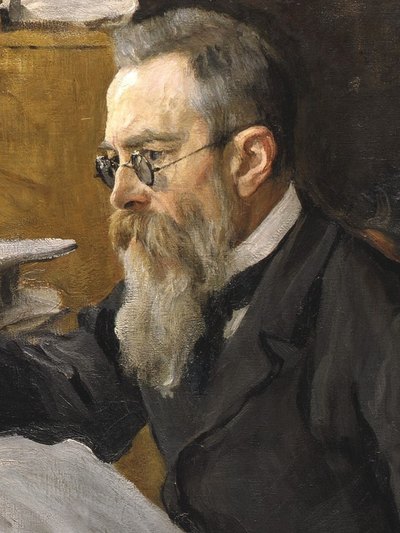
Nikolai Rimsky-Korsakov1844–1908Read the story of Rimsky-Korsakov →