Composers · 20th Century
Gustav Holst
Gustav Holst
- Life
- 1874–1934
- Born in
- Cheltenham, England
- Era
- 20th Century
The story of Holst
A girls' school in London, a small soundproof music room. On weekends and holidays the music teacher composes there alone. In that room the music of Mars, Venus and Jupiter was born. Gustav Holst remained a teacher at this school all his life.
The boy from Cheltenham
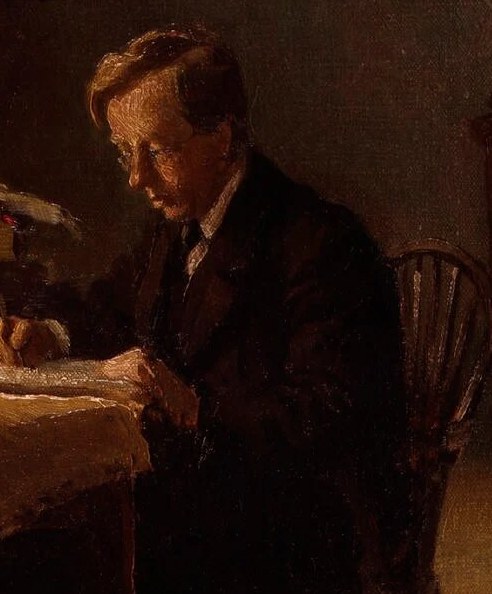
Holst was born in 1874 in Cheltenham, England, into a family of musicians who had come from Sweden; his father taught piano and played church organ. Losing his mother young, he was a frail child with poor eyesight. His father hoped he would become a pianist, but neuritis in his hand made that impossible.
Trombonist
Instead Holst studied composition at the Royal College of Music in London and learned the trombone. After graduating he made his living for a while playing trombone in theaters and orchestras. Experiencing instrumental sound from inside the orchestra later became the basis of his orchestral skill.
At college he met his lifelong friend Ralph Vaughan Williams. The two showed each other their new works first and exchanged frank opinions, and together they took a deep interest in England's fading folk songs.
Sanskrit and the stars
Drawn to ancient Indian literature and philosophy, Holst learned Sanskrit at University College London so he could read the sources himself, then translated hymns of the Rig Veda and set them to music. Through a friend he also became interested in astrology and reportedly cast his friends' horoscopes. That interest became the seed of The Planets.
St Paul's Girls' School
From 1905 until his death, Holst taught music at St Paul's Girls' School in London, writing the string piece St Paul's Suite for his pupils. He also taught for many years at Morley College, an evening school for working people, sharing the joy of ordinary people singing and playing together. From 1914 he wrote The Planets in the school's soundproof music room.
War and after
Unable to serve in the First World War for health reasons, near the war's end he took on the job of organizing music education for British troops in Greece and Turkey, shortly after dropping the German-sounding "von" from his name. The Planets brought great fame, which he reportedly did not much welcome. After falling from a podium in 1923 and injuring his head, his health declined, and he died in 1934 after surgery, at fifty-nine.
Music to hear on Pyeongeum
- "Jupiter, the Bringer of Jollity" from The Planets: festive and bustling, with a broad, stately melody at its heart.
After this, look for the other movements: Mars, bringer of war, charging in a menacing five-beat rhythm; Venus, bringer of peace, glimmering quietly; mysterious Neptune, ending as a distant women's choir fades away.
People around him
- Ralph Vaughan Williamsthe friend with whom he shared new works first all his life.
- Imogen Holsthis daughter and a musician, who wrote his biography and organized his works.
- The pupils of St Paul's and Morley College: the people he sang and played with all his life.
A question to think about
Even after becoming famous, Holst taught all his life at a girls' school and an evening school for workers. He believed music belonged not just to a few experts but to everyone. Today music and art classes in schools sometimes shrink, pushed aside by exam subjects.
Should arts education be for a few talented students, or is it something everyone's life needs?
Hidden stories about Holst
Composers of the same age
People whose lives overlapped with Holst's by more than ten years