
A Hymn Born From Music About the Planets
Holst's The Planets drew on astrology. The broad melody at the heart of "Jupiter" became, a few years later, a song the British still sing.
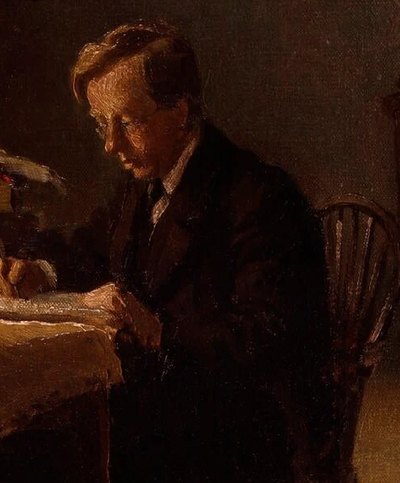
Horns burst out boldly while the strings sparkle and race without a pause. It is music as noisy as a festival. Then, in the middle, everything suddenly hushes, and low strings and horns begin a broad, stately melody. This is "Jupiter, the Bringer of Jollity," from Gustav Holst's The Planets.
Astrology, not astronomy
In 1914 Holst, a London music teacher, began an orchestral suite in seven movements. He taught for many years at a girls' school and composed on weekends and in the holidays. This work, too, he completed that way over several years.
The title is The Planets, but what Holst portrayed was not stars seen through a telescope; it was the characters astrology assigns to each planet. He was keenly interested in astrology and even cast friends' horoscopes. So Mars is "the Bringer of War," Venus "the Bringer of Peace," Jupiter "the Bringer of Jollity." Earth is missing, since in astrology Earth isn't one of the planets that shape your fate. There's no Pluto either: it was discovered only in 1930, long after the work was finished.
A first performance in wartime
The Planets was first performed in London in September 1918, just before the end of the First World War, for a small invited audience. The young Adrian Boult conducted. One can imagine how vividly "Mars," with its terror of war, struck listeners then.
That same year Holst dropped the German-sounding "von" from his name. His family had come from Sweden generations back, but in wartime a German-sounding name invited suspicion.
A melody turned into a song
A few years later Holst set that broad melody from the middle of "Jupiter" to a poem by the British diplomat Cecil Spring Rice. The song, "I Vow to Thee, My Country," became a hymn often sung in Britain at memorials and national occasions. Music that began with astrology became a nation's song.
When you listen, notice how different the two halves of "Jupiter" feel: the bustling, laughing outer sections, and the solemn tune in the middle that seems to stand still and look far away.
A question to think about
Holst changed his name during the war to avoid being taken for German, and the melody of "Jupiter" later became a song vowing to give one's life for one's country. War can make people hide where they come from, and demand that they prove their loyalty.
In war or conflict, is it ever right to suspect someone because of their origins or their name alone? How can we tell love of one's own country apart from hatred of other countries' people?
Gustav Holst1874–1934Read the story of Holst →