
A Waltz Meant to Console a Defeated City
The Blue Danube began as a men's choral piece with words. Meant to lift Vienna's gloom after a lost war, it made no great stir at first.
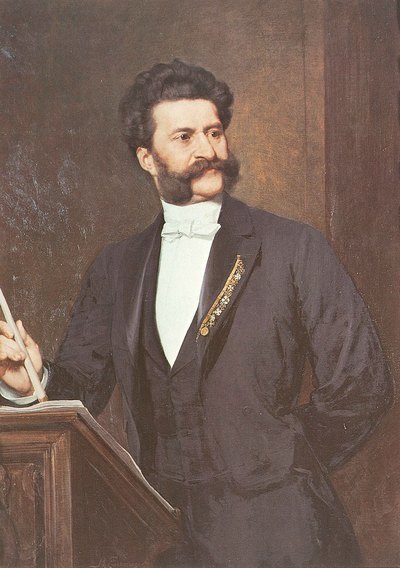
The strings shimmer very softly, and above them a horn rises quietly, like daybreak. Then the waltz begins: oom-pah-pah, oom-pah-pah. Every New Year's Day it rings out in Vienna's concert hall without fail: Johann Strauss II's The Blue Danube. Yet it began life as a song.
The winter of defeat
In summer 1866 Austria suffered a heavy defeat in its war with Prussia, and Vienna's mood sank. That winter, the Vienna Men's Choral Association asked Strauss, already called the Waltz King, for a new piece to sing at their carnival show.
Strauss wrote a waltz for the choir, and one of its members wrote the words. Those words, it is said, were less about the river's beauty than a satire urging people to laugh their way through gloomy times. At its first performance in February 1867 the reception was far from rapturous. Not a failure, but nothing that hinted at its later fame.
Reborn in Paris
That summer the World's Fair opened in Paris. There, among visitors from around the world, Strauss played the piece for orchestra alone, without singing. The reaction was entirely different. The waltz became a hit in Paris and soon spread across Europe and to America, and the sheet music is said to have sold in enormous numbers.
The choral words sung today were written much later, by someone else. And the phrase "blue Danube" in the title came from a line of a poem. A joke follows the piece that the real Danube is usually more murky than blue.
One line on a fan
There is a famous anecdote. The composer Brahms, signing a fan for Strauss's wife Adele, wrote out the opening bars of The Blue Danube and beneath them, "Unfortunately not by Johannes Brahms." Even Brahms, known for his seriousness, envied this waltz. The two were in fact friends who respected each other.
When you listen, notice that the piece is really a chain of several waltzes, each with its own tune, framed by a slow introduction and a closing section that brings back the most famous melody.
A question to think about
This waltz was written to ease the gloom of people in a city that had lost a war. At first it caused little stir; then it was loved at a festival in another country with no part in that war, and spread worldwide. Cheerful songs can comfort people who are suffering, but some criticize them for helping people forget their pain and cover up reality.
In hard times, is music and entertainment that makes people happy a comfort, or a way of turning their eyes away from problems they need to face?
Johann Strauss II1825–1899Read the story of Johann Strauss II →