
A Four-Hour Concert in a Freezing Theater
Beethoven's Fifth was first heard in winter 1808, one item in a concert of over four hours in an unheated hall. And how far can we trust the name "Fate"?
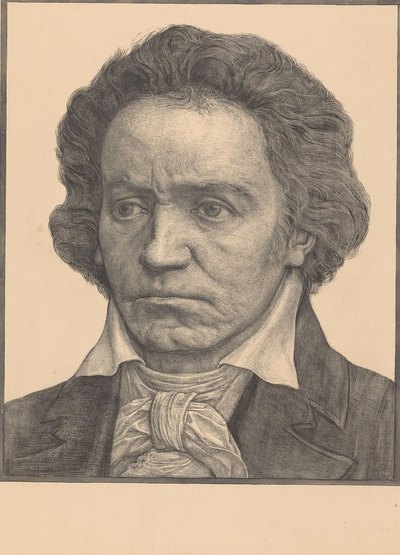
The piece in this story
Da-da-da-dum. Three short notes, one long. Even people who know nothing about classical music know these four notes. Yet on the day they first sounded, the audience was probably shivering, from the cold.
A concert that wouldn't end
22 December 1808, the Theater an der Wien, Vienna. Beethoven put on a huge concert of his own works, a benefit he organized himself to earn the proceeds. The program was staggering: the Fifth and Sixth (Pastoral) Symphonies, the Fourth Piano Concerto, parts of a mass, an aria, and the Choral Fantasy for piano, chorus and orchestra. Most of it was being performed for the first time.
The concert lasted more than four hours. The composer Reichardt, who was in the audience, recorded that he sat through it to the end in bitter cold. Rehearsal had been inadequate, too. In the final piece, the Choral Fantasy, the performance fell apart, and Beethoven reportedly stopped it and had it started again from the beginning.
Under such conditions the Fifth could hardly be judged fairly. But it was soon published, and in 1810 the writer and critic E. T. A. Hoffmann wrote a long review praising it ardently. From then on its fame steadily grew.
Who said "Fate"?
The work is often called the "Fate Symphony," because Beethoven supposedly said of the opening four notes, "Thus Fate knocks at the door." But the person who reported this was Anton Schindler, who acted as Beethoven's secretary. After Beethoven's death Schindler was later found to have written entries into Beethoven's conversation books that were never there, so his stories are considered unreliable. That is why the nickname is little used in English- and German-speaking countries.
From darkness into light
Whatever its nickname, the path this symphony traces is clear. Starting from a dark first movement in C minor, the music sinks almost to a whisper at the end of the third movement, then runs without a break into the fourth, bursting into the blazing light of C major. At that moment trombones, rarely used in symphonies until then, join in and the sound swells even further. Don't miss those few seconds of passing through darkness into light.
A question to think about
"Fate knocks at the door" has a doubtful source, yet for nearly two centuries it has served almost as this music's name. Fine words attributed to famous people spread easily without checking, and the internet is full of "famous quotes" of unknown origin.
Is it enough for a saying to be good, regardless of who said it? What harm does it do to keep spreading words falsely attributed to someone who never said them?
Ludwig van Beethoven1770–1827Read the story of Beethoven →