
The Habanera He Thought Was a Folk Song
The tune of Carmen's Habanera was not Bizet's own invention but came from a song by the Spanish composer Yradier. Bizet believed it was a folk song.
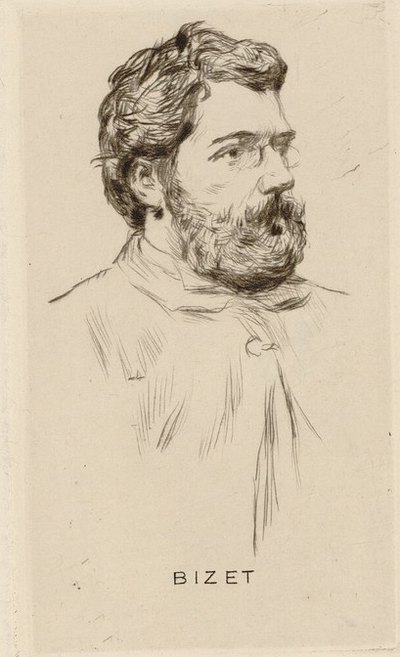
Down low, the cellos tread a sultry rhythm, over and over: dum, da-dum, dum, dum. Above it Carmen makes her entrance, singing a melody that slinks downward half step by half step: love is a rebellious bird that no one can tame. It is one of the most famous entrances in opera: the Habanera from Georges Bizet's Carmen.
An opera that began as a failure
In March 1875, Carmen was first staged at the Opéra-Comique in Paris. The theater was popular with family audiences, yet on stage were a free-spirited woman who worked in a cigarette factory, smugglers, a soldier blinded by jealousy, and even a death on stage. Many in the audience and press were uncomfortable, and the reception was cool.
Three months later, Bizet died suddenly at thirty-six. He never saw Carmen become one of the most frequently performed operas in the world.
Someone else's song
Writing the Habanera reportedly gave Bizet a hard time. Célestine Galli-Marié, who sang Carmen, wanted her entrance song revised until she was happy with it, and Bizet is said to have rewritten it several times.
The melody he ended up with was not, in fact, his own. It was taken almost directly from a song, "El arreglito," by the Spanish composer Sebastián Yradier. Bizet reportedly used it believing it was an anonymous Spanish folk song. Yradier had died about ten years before Bizet. When Bizet learned the truth, he added a note to the score identifying the melody's source as Yradier's song.
A rhythm from Havana
The name "habanera" refers to a dance and song from Havana, the capital of Cuba, with an easy yet clinging, swaying rhythm. That rhythm crossed the sea to Spain, to Europe and throughout the Americas. From Cuba to Spain, from a Spaniard's song to a Frenchman's opera: a single Habanera carries the long journey of music back and forth across the Atlantic.
When you listen, follow the singer's line downward and notice how each phrase seems to slip away just as you reach for it, exactly like the "bird" she sings about.
A question to think about
Bizet took a song someone else had written, mistaking it for a folk song, and later acknowledged the fact in his score. Even today, writing, images and music used without knowing their source often turn out later to be someone else's creation.
If you used another's work without knowing, is naming the source afterwards enough to meet your responsibility? How should profits earned from that work be shared with the person who made it?
Georges Bizet1838–1875Read the story of Bizet →