The story of Mussorgsky
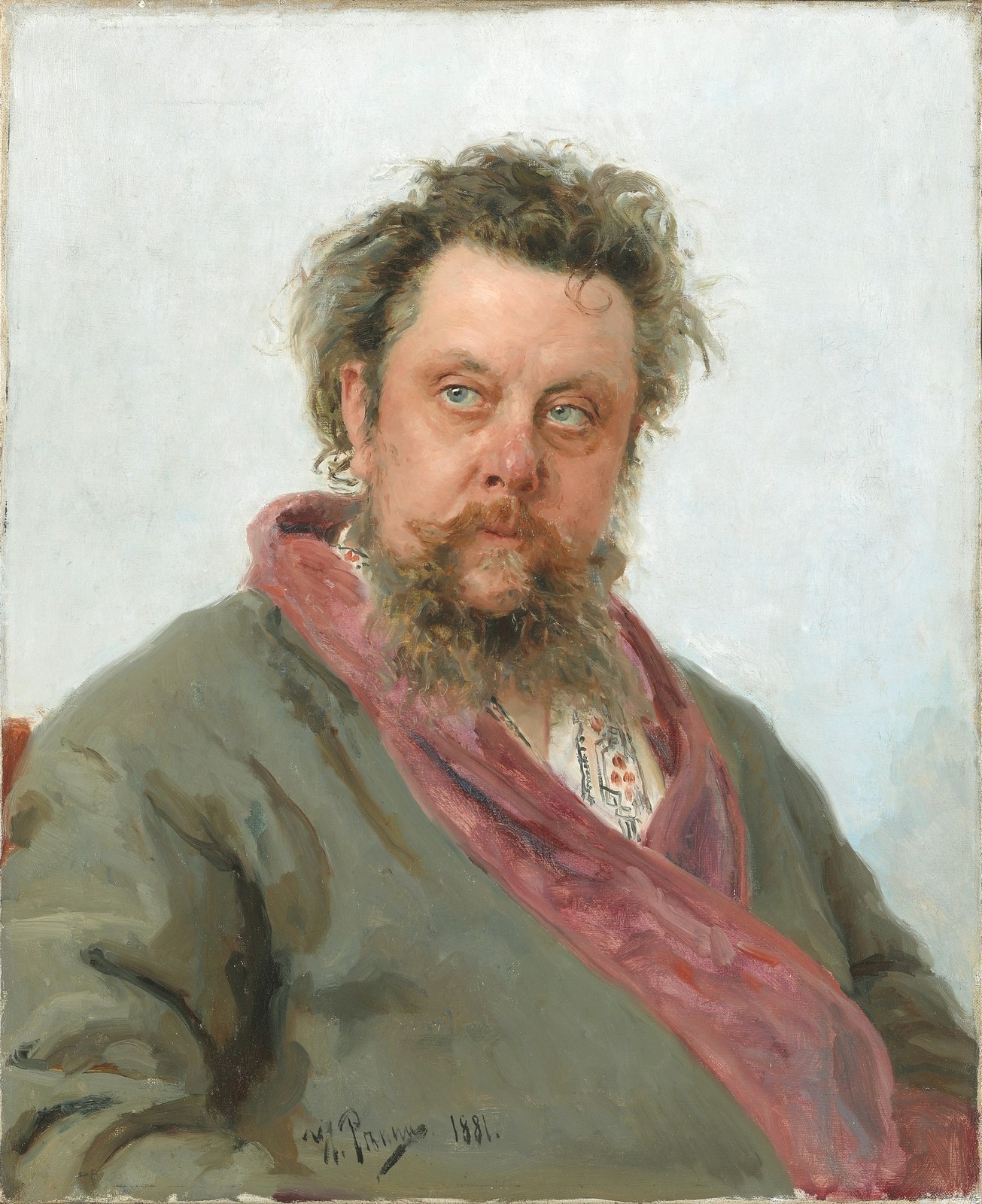
March 1881, a military hospital in St Petersburg. The painter Ilya Repin paints a man sitting by his sickbed: tousled hair, reddened nose, a dressing gown. A few days after Repin finished the portrait, the man died at forty-two. The painting remains the most familiar image of Modest Mussorgsky.
The boy on a country estate
Mussorgsky was born in 1839 at Karevo, a country estate in the Pskov region of Russia, the son of a noble landowning family. He learned piano from his mother and grew up hearing Russian folk tales from his nurse and the songs of peasants. These memories flowed beneath his music all his life.
Guards officer
Following family wishes, he entered a cadet school in St Petersburg and became an officer in a famous guards regiment. But music drew him more than military life. After meeting the composers Dargomyzhsky and Balakirev, he resigned from the army in 1858 and threw himself into music.
The Five
A circle of young composers centered on Balakirev included Mussorgsky, Rimsky-Korsakov, Borodin and Cui. Rather than follow the rules of European conservatories, they resolved to create a truly Russian music; the group was later called "The Five." Mussorgsky had the least formal training of them all, yet sought the boldest sounds.
Emancipation and the civil service
When Russia emancipated its serfs in 1861, his family, which depended on serf labor, lost much of its wealth. Mussorgsky had to work as a junior clerk in government offices to earn a living, writing documents by day and composing at night. From 1871 he even shared a room for a time with Rimsky-Korsakov.
Boris Godunov
He wrote the opera Boris Godunov, based on Pushkin's play: a bold work with melodies that keep the inflections of Russian speech and that put the common people on stage almost as a protagonist. The theater rejected it at first, but he revised it and finally saw it staged in 1874. That same year he wrote Pictures at an Exhibition in memory of his friend Hartmann.
A collapsing end
But for years he had sunk into drink, ruining his health and losing his government job. Getting by with friends' help, he died in hospital in 1881. Many of his works were left unfinished or in disorder, and Rimsky-Korsakov polished them and brought them to the world. Later, people came to feel that Mussorgsky's rough original scores carried even greater power.
Music to hear on Pyeongeum
- "The Great Gate of Kyiv" from Pictures at an Exhibition: a city gate a friend designed but never saw built, raised in sound.
People around him
- Mily Balakirevthe composer who led "The Five," a friend who was almost a teacher.
- Nikolai Rimsky-Korsakovthe friend who shared his room and organized his works after his death.
- Viktor Hartmannthe artist and architect friend who inspired Pictures at an Exhibition.
- Ilya Repinthe painter of his last portrait.
A question to think about
After Mussorgsky's death his rough scores were smoothed out by a friend, yet later listeners felt the rough originals had greater power. "Improving" someone else's work can sometimes erase its character.
When we revise or polish someone else's work, what must we take care to do to protect the original maker's voice?
Composers of the same age
People whose lives overlapped with Mussorgsky's by more than ten years