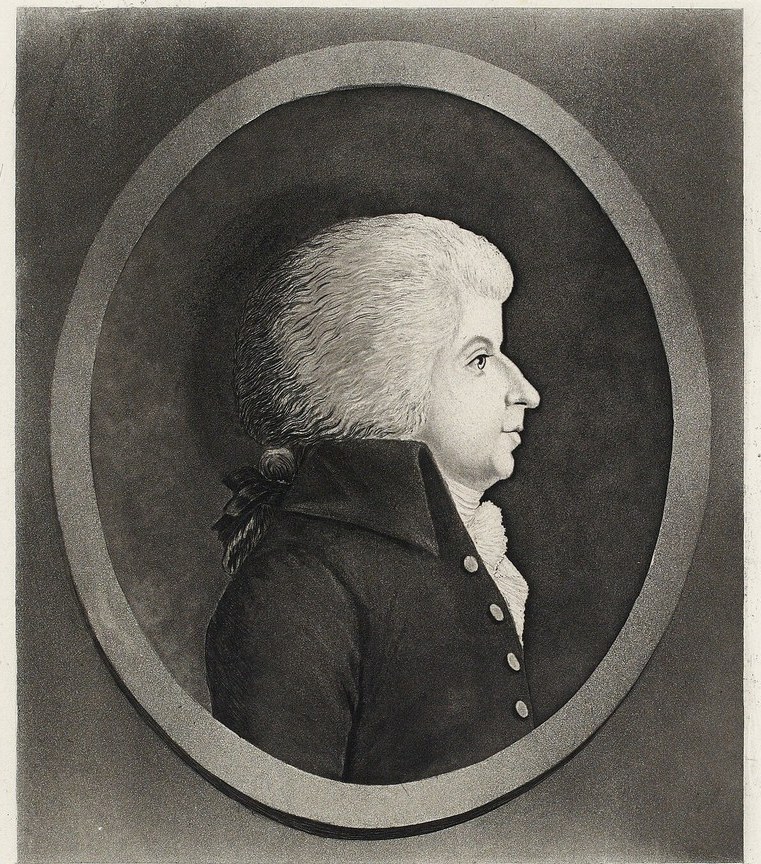
Composers · Classical
Wolfgang Amadeus Mozart
Wolfgang Amadeus Mozart
- Life
- 1756–1791
- Born in
- Salzburg, Austria
- Era
- Classical
The story of Mozart
1762. A six-year-old boy sits at the keyboard before the Empress in a Viennese palace. When he finishes, according to his father's letter, he jumps into the Empress's lap and kisses her. It was one of Wolfgang Amadeus Mozart's first stages.
The prodigy's travels
Mozart was born in Salzburg, Austria, in 1756. His father Leopold was a musician at the court of the Archbishop of Salzburg and author of a well-known violin method. Recognizing the talent of his son and his daughter Nannerl, five years older, Leopold took them around Europe's courts: Munich, Vienna, Paris, all the way to London, on a journey of more than three years from 1763.
In London the young Mozart met Johann Christian Bach, the youngest son of J. S. Bach, and was strongly influenced by him. As a teenager he traveled to Italy several times with his father, learning opera and staging his own operas in Milan.
Leaving Salzburg
As an adult, Mozart served under Archbishop Colloredo in his hometown. But court life, in which he was treated like a servant, did not suit him. In 1781, after a fierce quarrel with the archbishop, he left the post. According to Mozart's letter to his father, the archbishop's steward saw him out with a kick.
Mozart then settled in Vienna and chose to live without a fixed employer, from lessons, concerts, commissions and publishing, an unusual choice at the time. The following year, against his father's wishes, he married Constanze Weber.
Ten years in Vienna
His first years in Vienna were dazzling. Concerts where he played his own piano concertos made him hugely popular. Operatic masterpieces followed: The Marriage of Figaro in 1786, Don Giovanni premiered in Prague in 1787, and The Magic Flute in 1791. He and Haydn became friends who deeply respected each other.
But money was never plentiful. In the late 1780s, as his popularity in Vienna faded and war reduced aristocratic patronage, he repeatedly wrote to a friend asking for loans. Mozart and Constanze had six children, but only two sons grew to adulthood.
1791
Even in his last year he never stopped. He staged The Magic Flute and La clemenza di Tito, completed the Clarinet Concerto, and worked on a requiem commissioned anonymously. On 5 December 1791 Mozart died at thirty-five, the Requiem unfinished. Under Vienna's regulations of the time he was buried in an ordinary grave shared with others, so his exact resting place is unknown.
Music to hear on Pyeongeum
- Eine kleine Nachtmusik, first movement: the fourth stop on our Music Journey, a string serenade completed in summer 1787.
- Symphony No. 40 first movement, Piano Concerto No. 21 second movement, Clarinet Concerto second movement, Piano Sonata No. 16 first movement, the "Turkish March," and the Lacrimosa from the Requiem.
People around him
- His father Leopoldfirst teacher and manager, who worried about his son's future more than anyone.
- His sister Nannerla brilliant keyboard player who toured Europe with him, yet as an adult was no longer allowed to tour.
- His wife Constanzewho worked to protect his scores and his name after his death.
- Joseph Haydnthe older friend to whom Mozart dedicated six string quartets.
A question to think about
His sister Nannerl had also astonished Europe as a child performer, yet when she reached marriageable age she had to leave the stage. In that era the path of a musician was almost closed to women. Today we remember only Mozart's name.
Thinking of people denied opportunities because of their gender despite their talent, whose paths are still blocked in our society today?
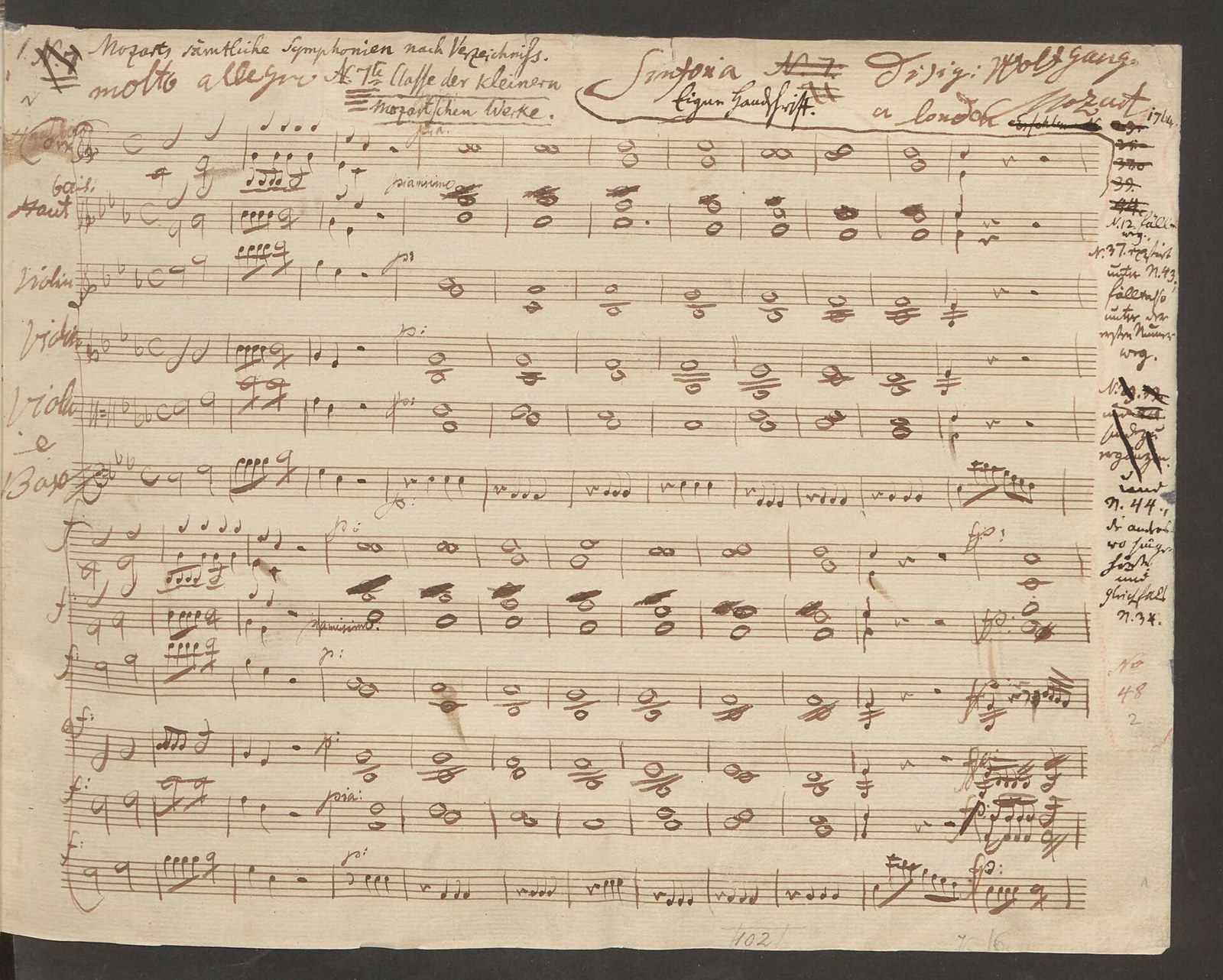
In the composer's own hand
Pieces along a life
Each dot is a piece on Pyeongeumjae — tap one to open it. The year is whichever is confirmed: composed, completed, published or premiered.
Pieces by Mozart
- Symphony No. 40I. Molto allegro · completed 1788 · aged about 32 · about 8 min
- Violin Concerto No. 1Movement I · about 6 min
- Violin Concerto No. 1III. Presto · about 5 min
- Oboe Concerto in C majorMovement III · about 6 min
- Piano Sonata No. 11I. Andante · about 14 min
- Sonata No. 13III. Allegretto · about 7 min
- Symphony No. 40Movement III · about 4 min
- Rondo in A majorabout 9 min
Hidden stories about Mozart
Composers of the same age
People whose lives overlapped with Mozart's by more than ten years