
Details
- Composer
- Johann Sebastian Bach
- Catalogue no.
- BWV 1001
- Key
- G minor
- Scoring
- Solo strings
- Length
- about 5 min
Recording
Morning music at 7
About this piece
The violin usually sings one line at a time. In this piece, though, Bach asked one violin to carry both the accompaniment and the melody.
At a glance
- What it isthe first movement of Sonata No. 1 for unaccompanied violin. The slow Adagio is followed by a fugue.
- Who, when, whya clean autograph copy survives from 1720, when Bach was working in Köthen. He gathered three sonatas and three partitas for solo violin into one set.
- What to listen forchords sounded on several strings at once, and the finely divided ornaments that link them.
Listen for
- The first chordthe violin draws its bow across three or four strings at once and sounds a weighty G minor chord, as if starting a small ensemble on its own.
- The flow of ornamentsrapid notes wind between the chords. Bach wrote out, note by note, the decoration that players would normally have improvised.
- The last chordhaving travelled through several keys, the line returns to G minor and gets ready for the fugue that follows.
When it was written
In 1717 Bach became music director to Prince Leopold of Köthen. It was a Calvinist court that needed little elaborate church music, and thanks to a prince who loved music, Bach could pour his energy into instrumental works. The autograph of the solo violin set bears the year 1720.
That same year, while Bach was away with the prince at the spa town of Carlsbad, his wife Maria Barbara died. Whether the set has any connection with that loss cannot be known. For a long time these pieces were thought of as practice material, and they became widely known only when nineteenth-century violinists such as Joseph Joachim played them in concert.
A question to think about
In this piece one violin manages both accompaniment and melody. Listeners hear something like several players, but in fact one person carries the whole weight. Today, too, some people must do the work of several on their own.
When one person takes on many roles alone, is it a chance to show what they can do, or a burden that others ought to share?
The composer
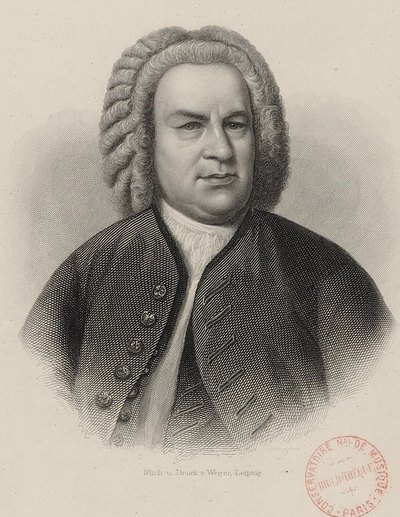 Johann Sebastian Bach1685–1750 · born in Eisenach, GermanyMore on Bach →
For moods like
Sad · Tired · Focused
slow · minor key · energy 1
Find more pieces in Listen by Mood →More by Bach
- Brandenburg Concerto No. 3I. Allegro · completed 1721 · about 6 min
- The Well-Tempered Clavier, Book I: Prelude No. 1completed 1722 · about 2 min
- Cello Suite No. 1Movement II · about 4 min
- Cello Suite No. 1Movement III · about 3 min
- Organ Sonata in E-flat majorMovement I · about 3 min
- Organ Sonata in E-flat majorMovement III · about 4 min
- Organ Sonata in C minorMovement I · about 4 min
- Organ Sonata in C minorMovement III · about 5 min