
Bach · Baroque
Brandenburg Concerto No. 3
I. Allegro
Johann Sebastian Bach
The third of six concertos Bach dedicated to the Margrave of Brandenburg in 1721
Details
- Composer
- Johann Sebastian Bach
- When
- completed 1721
- Catalogue no.
- BWV 1048
- Key
- G major
- Scoring
- String ensemble
- Length
- about 6 min
Recording
Morning music at 7
Track info
「Brandenburg Concerto No. 3」Performed by the Advent Chamber OrchestraWikimedia CommonsCC BY-SA 2.0
About this piece
This concerto has no soloist who steps forward. Instead three violins, three violas and three cellos form three groups, and nine parts sing together and apart. And in the score of the slow middle movement there are only two chords.
At a glance
- What it isNo. 3 in G major of the six Brandenburg Concertos. Between two fast movements stands a short Adagio of two chords.
- Who, when, whyin 1721, while working in Köthen, Bach made a fair copy of six concertos and dedicated them to Christian Ludwig, Margrave of Brandenburg.
- What to listen forthe moments when the nine parts sound with one voice and then split into three groups trading phrases.
Listen for
- One voicethe first movement begins with all the strings sounding a vigorous theme together.
- Three groupssoon the violins, violas and cellos toss short figures back and forth. Follow the same pattern as it moves from high to low.
- Two chordsplayers fill the middle movement's two chords with improvisation, or insert another slow piece. Then the fast finale follows like a dance.
When it was written
In March 1721 Bach sent the margrave the scores of six concertos together with a courteous dedication written in French. He wrote that he had once played before the margrave in Berlin and had been asked then to send him some music. Some see in it the hopes of a Bach looking for a new position.
Yet there is no record that the concertos were ever performed at the margrave's court. After the margrave's death the manuscript passed elsewhere, and the music became widely known only when it was published in the nineteenth century. Each of the six has a different combination of instruments, so the set is regarded as Bach's experiment with instrumental combinations.
A question to think about
Bach dedicated these pieces with care, but their recipient seems never to have played them. Even so, the score survived and is now performed all over the world.
When work done with full devotion is buried with no one to recognize it at the time, has it failed? What kinds of work are meaningful even if they are not recognized now?
In the composer's life
completed 1721 · Bach, aged about 36
The composer
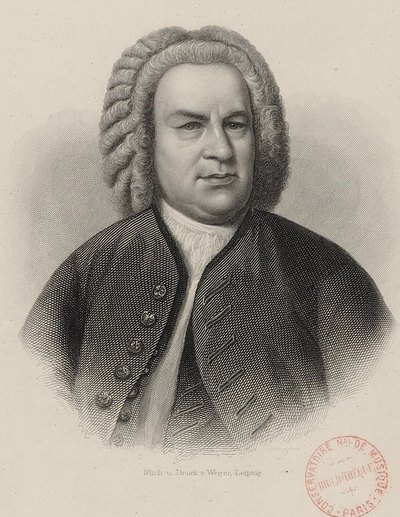 Johann Sebastian Bach1685–1750 · born in Eisenach, GermanyMore on Bach →
For moods like
Joyful · Restless · Focused
fast · major key · energy 4
Find more pieces in Listen by Mood →More by Bach
- The Well-Tempered Clavier, Book I: Prelude No. 1completed 1722 · about 2 min
- Violin Sonata No. 1I. Adagio · about 5 min
- Cello Suite No. 1Movement II · about 4 min
- Cello Suite No. 1Movement III · about 3 min
- Organ Sonata in E-flat majorMovement I · about 3 min
- Organ Sonata in E-flat majorMovement III · about 4 min
- Organ Sonata in C minorMovement I · about 4 min
- Organ Sonata in C minorMovement III · about 5 min