
Details
- Composer
- Johann Sebastian Bach
- Catalogue no.
- BWV 1007
- Key
- G major
- Scoring
- Solo strings
- Length
- about 3 min
Recording
Morning music at 7
Track info
「Cello Suite No. 1」Performed by Darrell Jacobirecorded 2012Wikimedia CommonsCC BY 3.0
About this piece
The courante takes its name from a word meaning 'to run'. Coming after the calm Allemande, this movement sets the cello running lightly, just as its name promises.
At a glance
- What it isthe third movement of Cello Suite No. 1, a quick dance in triple time.
- Who, when, whythought to date from Bach's Köthen years, around 1720. His suites take allemande, courante, sarabande and gigue as their basic order.
- What to listen forwithin the constant running notes, the way high and low registers take turns.
Listen for
- The openingthe cello sets off with a figure that leaps upward. The pace is clearly quicker than in the Allemande.
- Two voicestouching high and low notes in turn, one cello sounds like two people trading lines.
- The endingboth halves close with the same rhythm, signalling that one round of the dance is complete.
When it was written
There were two kinds of courante. The French kind was an elegant dance that shifted its beat about; the Italian corrente was a dance that ran quickly. With its even notes running without pause, this movement is closer to the Italian kind. Bach gathered dances from several countries into one suite, like a small tour of Europe.
When the suites were written, Bach was serving Prince Leopold at the court of Köthen. The prince played instruments himself, and the court orchestra had skilled players. But there is no record of which cellist first played this music.
A question to think about
Bach put dances from France, Italy, Germany and elsewhere together in a single suite. Things from different places sit side by side in one work.
Is making something new by mixing what comes from many cultures a kind of richness, or does it blur what is distinctive about each? If there is something to protect when mixing, what is it?
The composer
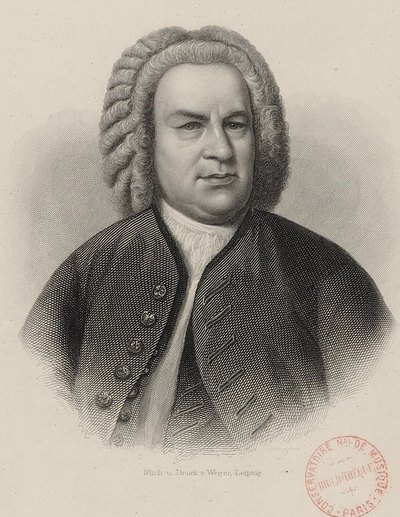 Johann Sebastian Bach1685–1750 · born in Eisenach, GermanyMore on Bach →
For moods like
Excited · Joyful
fast · major key · energy 4
Find more pieces in Listen by Mood →More by Bach
- Brandenburg Concerto No. 3I. Allegro · completed 1721 · about 6 min
- The Well-Tempered Clavier, Book I: Prelude No. 1completed 1722 · about 2 min
- Violin Sonata No. 1I. Adagio · about 5 min
- Cello Suite No. 1Movement II · about 4 min
- Organ Sonata in E-flat majorMovement I · about 3 min
- Organ Sonata in E-flat majorMovement III · about 4 min
- Organ Sonata in C minorMovement I · about 4 min
- Organ Sonata in C minorMovement III · about 5 min