
VOL. 11 · Track 12 · 12 / 15
The Left Hand Walks, the Right Hand Skips
A piano score published in a small Missouri town in 1899 spread to parlor pianos across America. The dawn of jazz is breaking.
Until membership opens, all fifteen stories stay free.
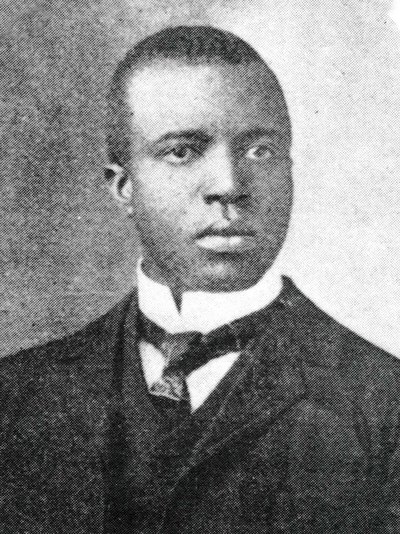 The composer of this pieceScott Joplinc. 1868–1917
Sedalia, a railroad town in Missouri. On its streets stood a club called the Maple Leaf Club, and at its piano a Black pianist named Scott Joplin often sat. Stop twelve: we've left Europe and crossed to America.
Joplin was born in Texas and grew up the son of a railroad laborer. He played piano in town after town, and in Sedalia he studied music further at a college for Black students. Then, in 1899, a local music publisher, John Stark, brought out his "Maple Leaf Rag." The contract they signed still survives: Joplin was to receive one cent for every copy sold.
The sheet music sold steadily for years and spread to parlor pianos across America. In an age with few radios or records, people met new music by buying the score and playing it themselves.
The secret of ragtime is the friction between the hands. The left hand alternates a low note and a chord, "oom-pah, oom-pah," marching along like a band. The right hand deliberately dodges the beat, skipping in between. This twisting of rhythm is called syncopation. The name ragtime is said to come from "ragged time."
Joplin even left a warning that ragtime should never be played fast. For him it was not saloon noise but carefully crafted composition.
Listen for this
- The first strainwhile the right hand pops off the beat, the left hand keeps walking. Try listening to each hand on its own.
- Where the tunes changethe piece has four different strains in turn, and the first returns once in the middle. Raise a finger each time a new one begins.
- The last strainit rings out boldly in the low register and brings the piece home.
A question to think about
Joplin went on to write an opera, Treemonisha, but never saw it properly staged in his lifetime. It received a full production more than half a century after his death, and only in 1976 was he awarded a special Pulitzer Prize. It was an era when Black composers struggled to reach major stages.
If a gifted person was denied opportunities because of race or background, can a late prize and praise ever repay that debt?
The piece at this track
Joplin · about 3 min
Track info
「Maple Leaf Rag」Performed by Gnissahrecorded 2024Wikimedia CommonsPublic Domain