
VOL. 11 · Track 13 · 13 / 15
Moonlight Borrowed From a Poem
Debussy's "Clair de lune" takes its title from Verlaine's poem, which even hides the suite's name, "bergamasque."
Until membership opens, all fifteen stories stay free.
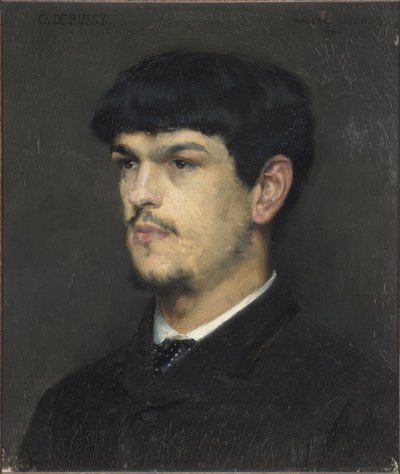 The composer of this pieceClaude Debussy1862–1918 · born in Saint-Germain-en-Laye, France
A very small sound from the piano. Chords of two notes drift slowly downward, and it is hard to tell where the beat begins, as if moonlight were leaking little by little between clouds. Stop thirteen: Debussy's "Clair de lune."
The title comes from the French poet Paul Verlaine's poem "Clair de lune." It begins by saying that your soul is like a chosen landscape where masked figures go about in "masques et bergamasques," playing the lute and dancing. They sing cheerfully, yet seem secretly sad, and at the end their song melts into the moonlight.
Did you notice? The name of the suite this piece belongs to, Suite bergamasque, is that very word from the poem. A bergamasque was an old dance from the Bergamo region of Italy, and the word also suggested the clowns who danced it.
Debussy first wrote the suite around 1890, in his late twenties, before he was well known. But he held it back for years, revised it, and only published it in 1905. By then he had made his name with the opera Pelléas et Mélisande.
Debussy treated chords less as steps in a rulebook than as colors and light. That is why his music calls up a landscape before it tells a story. If you see moonlight in this piece, it is a picture Debussy painted in sound.
Listen for this
- The openingvery softly, paired notes drift slowly down. Don't count beats; just follow the sound as it floats.
- The middle sectionthe left hand ripples on without stopping, and the melody swells a little warmer.
- The endingthe first melody returns, even quieter, fading until it can hardly be heard.
A question to think about
The people in Verlaine's poem sing and dance happily while carrying sadness inside. Today we, too, live in spaces where photos and posts show only cheerful faces.
In a society where outward happiness and inner feeling keep drifting apart, what would it take for people to recognize what others truly feel?
The piece at this track
Debussy · about 5 min
Recording on its way