
VOL. 11 · Track 11 · 11 / 15
A Song of Home Written in New York
The Czech composer Dvořák wrote "From the New World" in America. Its slow movement's tune was later reborn as a song.
Until membership opens, all fifteen stories stay free.
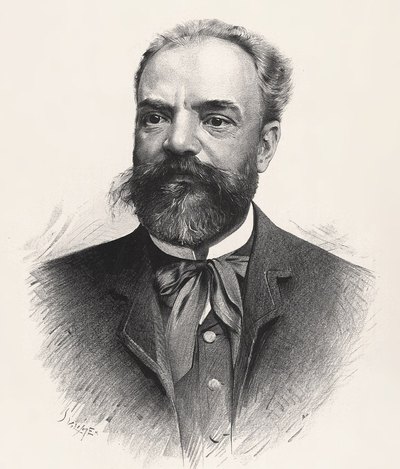 The composer of this pieceAntonín Dvořák1841–1904 · born in Nelahozeves, Czech Republic
Carnegie Hall, New York, December 1893. As a symphony's slow movement ends, applause breaks out. Clapping between movements isn't done, but that audience reportedly couldn't hold back. The composer rose in his box to bow. He was Antonín Dvořák, from Bohemia.
This is the eleventh stop. Dvořák arrived in New York in autumn 1892 to direct the new National Conservatory of Music. Born the son of a village butcher, he had become the leading Czech composer, and now he would spend several years in a strange city across the Atlantic.
He thought hard about what American music could become. His student Harry Burleigh, an African American singer, sang spirituals for him, and Dvořák was deeply moved. He even said that the future music of America lay in songs like these.
He gave the symphony its subtitle himself: "From the New World." It is music like a letter sent home from a new world.
The star of the slow second movement is the English horn, a woodwind that is neither English nor a horn. Slightly larger and lower than an oboe, it has a warm, lonely voice. Its melody was later given words by Dvořák's pupil William Arms Fisher and became the song "Goin' Home." Many people assume the tune is a spiritual, but Dvořák wrote it.
Listen for this
- The openinga few slow chords from the winds and brass open the door, the light shifting like a sky at dusk.
- The English horn's songover a quiet bed of strings, that warm, lonely voice sings the melody.
- The endingthe first melody returns, and at the very end the double basses close the movement with a low, quiet chord.
A question to think about
Dvořák saw the future of American music in spirituals, which the American music world of his time largely ignored. Yet the people who had kept those songs alive faced severe discrimination in the same country.
If a society praises the beauty of a people's culture but does not treat those people as equals, what is that praise missing?
The piece at this track
Dvořák · II. Largo · about 12 min
Track info
「Symphony No. 9 'From the New World'」Performed by MusopenWikimedia CommonsPublic Domain