
The Composer Who Couldn't Hear the Applause
When the Ninth Symphony ended in Vienna in 1824, Beethoven stood with his back to the audience. He had to see the applause.
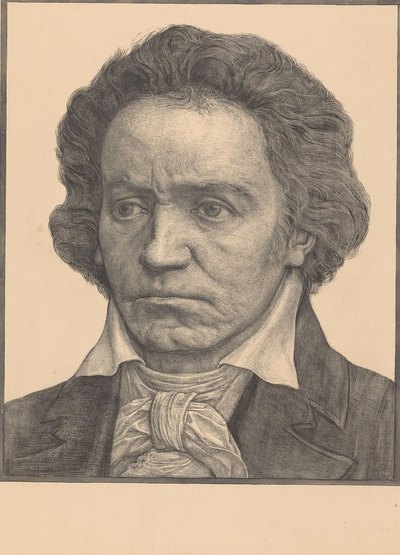
The last chord rings out and the theater erupts. People rise, clapping, waving handkerchiefs. Yet one man on stage stands with his back to the hall, looking at the score. He is Ludwig van Beethoven, fifty-three, the man who wrote the symphony just played. He cannot hear the applause.
A poem carried for thirty years
On 7 May 1824, at the Kärntnertor Theater in Vienna, Beethoven's Ninth Symphony was performed for the first time, roughly ten years after his Eighth. In the meantime his hearing had gone almost completely, and he conversed with people by having them write in notebooks.
Something remarkable happens in the last movement: a choir and solo singers enter a symphony. The words are from Friedrich Schiller's poem "An die Freude," To Joy, which sings that all people will become brothers.
Setting this poem was an old dream of Beethoven's. When he was about twenty-two and still living in his hometown of Bonn, an acquaintance wrote to Schiller's wife that this young man intended to set "An die Freude" to music. Some thirty years later, that intention became this movement.
"Not these sounds"
The finale does not begin with singing. The orchestra recalls the themes of the three earlier movements one by one, and the low strings, almost as if speaking, wave each away. At last a new melody, the "Ode to Joy" tune we all know, begins very low and quiet.
When the baritone rises, his first words are not Schiller's. "O friends, not these sounds! Let us sing something more pleasant, more full of joy." Beethoven wrote that opening line himself.
Turned around to see
At the premiere the actual conducting was done by Michael Umlauf, with Beethoven standing beside him indicating the tempos. When the music ended, it is said, Beethoven was still facing away from the audience. The young contralto soloist Caroline Unger took his arm and turned him toward the hall, and only then did he see the standing crowd and the waving hats and handkerchiefs.
The scene comes down to us through several people's memories, so the details vary. Still, the image of a deaf composer seeing his applause has stayed with listeners ever since.
A question to think about
After losing his hearing, Beethoven had to read what others wrote in order to converse, and on the night of his premiere he needed someone else's hand just to see how the audience responded. Today, deaf people still often struggle to get information in theaters, hospitals and public offices.
Like this music that sings of all people as brothers, what around us would need to change first so that people with disabilities can enjoy performances and information on equal terms?
Ludwig van Beethoven1770–1827Read the story of Beethoven →