
A Sea Drawn Into a Letter
Writing home from the Scottish islands at twenty, Mendelssohn sent a few lines of music instead of words. They became the opening of The Hebrides.
August 1829, the far western coast of Scotland. Felix Mendelssohn, twenty years old, is writing to his family in Berlin. Instead of describing the scenery in words, he jots down a few lines of music, sending what came to him there to show how extraordinarily the Hebrides had affected him.
The young traveller
Mendelssohn grew up in a wealthy Berlin banking family. From childhood he studied music, drawing and several languages, and by sixteen he was already writing astonishing pieces. That spring he had caused a sensation in Berlin by conducting Bach's St Matthew Passion, which had gone almost a century without a proper performance.
That summer he set off with his friend Karl Klingemann, travelling through England to Scotland. Past castles, lochs and rugged mountains, they finally reached the Hebrides, the islands scattered across the western sea.
An opening like the waves
The sketch in the letter shows low strings repeating a short figure like a swell. It became the opening of The Hebrides overture: a melody that rolls in, draws back, and rolls in again at a slightly different height, just like waves.
Around then Mendelssohn also visited Fingal's Cave on the island of Staffa, a sea cave lined with huge columns of rock, still famous today. That is why the overture is also called Fingal's Cave. Yet the sketch was already in a letter written before the cave visit, so it is fairer to say the whole sea, not just the cave, gave birth to the piece. Klingemann reported that on that boat trip Mendelssohn suffered badly from seasickness.
Polishing and polishing
Mendelssohn did not finish the work in one go. Even after completing it, he revised it several times, trimming passages he felt were overdone. The polished overture was first performed in London in 1832.
Listen and you'll notice it tells no particular story. Instead it paints the colors of the sea, the wind, the feeling of a sailors' song in the distance. Over the low strings' swell, listen for the broad, warm melody that cellos and bassoons sing partway through.
A question to think about
Mendelssohn was deeply moved by a seascape he was seeing for the first time, and left that feeling to us in music. The Hebridean sea and islands he saw are slowly changing today with climate change and growing tourism, and Staffa, home of Fingal's Cave, is protected.
When opening beautiful nature to more people clashes with keeping it from being damaged, which should we weigh more heavily?
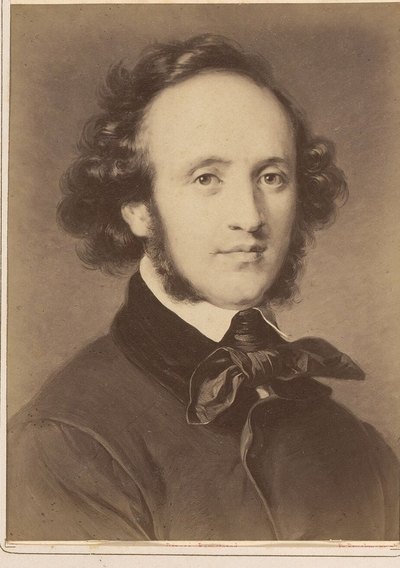
Felix Mendelssohn1809–1847Read the story of Mendelssohn →