
The Symphony That Slept in a Friend's Drawer for 43 Years
The score of Schubert's Unfinished Symphony passed to his friend Hüttenbrenner and stayed unknown for decades. It was premiered 43 years after it was written.
Low cellos and double basses begin in the dark, almost whispering, very quietly, as if something were hiding. Above them the violins ripple nervously, and oboe and clarinet sing a lonely song together. Then, a little later, the cellos sing the warm melody almost everyone has heard at some point. This is Schubert's Symphony in B minor, the "Unfinished."
Two movements and half a scherzo
In autumn 1822, Franz Schubert, twenty-five, began a new symphony. He completed the first two movements in full score. He also started a third movement, a scherzo, but sketched most of it for piano and wrote only a few pages of orchestral score before setting it aside. He never came back to it.
People often assume he died before finishing it, but that is not so. Schubert lived six more years after laying it down, and in that time he even completed another large symphony. Why he left this one unfinished remains a mystery.
Into the drawer
The next year Schubert received an honorary diploma from the music society in Graz, Austria. Some time afterwards, the score of this symphony passed into the hands of his friend Anselm Hüttenbrenner, who lived in Graz. It is often explained as a gesture of thanks to the society, but the exact circumstances are not recorded.
Strangely, Hüttenbrenner showed the score to no one, not even after Schubert died in 1828 at thirty-one. And so it slept in his drawer for decades.
First sound after 43 years
In 1865 the Viennese conductor Johann Herbeck finally visited the elderly Hüttenbrenner and obtained the score. That December the symphony sounded for the first time in Vienna, 43 years after Schubert began it, music its composer never once heard.
With only two movements, it soon became one of Schubert's signature works. Many listeners felt that being unfinished left an even deeper echo.
When you listen, notice how the two movements answer each other. The first is restless and shadowed, full of sudden outbursts; the second, in a gentler major key, seems to look back on that turmoil from a calmer place.
A question to think about
Hüttenbrenner kept his friend's precious score to himself for over forty years, and all that time the world did not know this music. Even today, important works and documents often sleep in private drawers and storerooms.
Even if someone has rightfully inherited a work, if it is meaningful heritage for everyone, do they have a duty to make it public? Where should we draw the line between private ownership and shared cultural heritage?
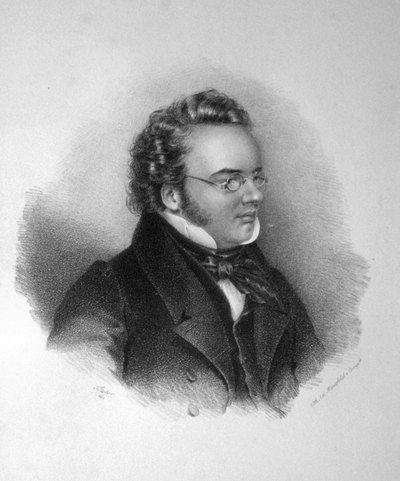
Franz Schubert1797–1828Read the story of Schubert →