
VOL. 11 · Track 9 · 9 / 15
A Dance for Four Hands
Brahms's Hungarian Dances were first written for two people sharing one piano, and he gave them no opus number.
Until membership opens, all fifteen stories stay free.
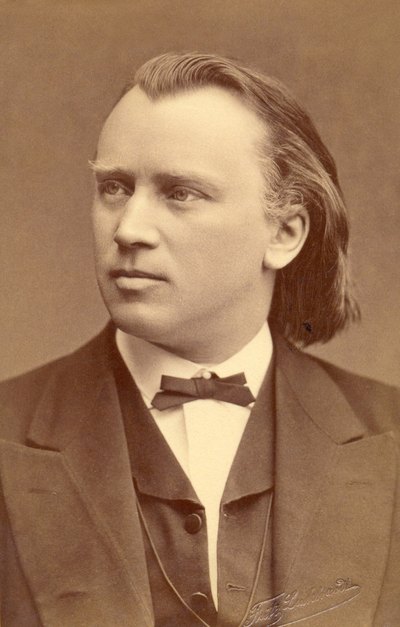 The composer of this pieceJohannes Brahms1833–1897 · born in Hamburg, Germany
One piano, two chairs. Two people sit shoulder to shoulder and race across the keys with four hands. Stop nine, Brahms's Hungarian Dance No. 5, was born in exactly this form.
In 1853, when he was about nineteen, Johannes Brahms from Hamburg toured as accompanist to the Hungarian violinist Ede Reményi. Reményi loved playing music in the style of Hungarian Roma bands, and young Brahms fell hard for those rhythms and tunes.
More than a decade later, Brahms turned the melodies he had absorbed into piano duets, pieces for two players at one keyboard. The first two books, ten dances, appeared in 1869. Many European homes then had a piano, and sitting side by side with family or friends to play duets was a great pleasure. The music sold extremely well.
Yet Brahms gave the set no opus number. He considered the melodies not his own inventions but existing tunes he had arranged. Indeed, the main melody of No. 5 turned out to come from a csárdás by the Hungarian composer Béla Kéler. Even the orchestral version of No. 5 we usually hear was made by someone other than Brahms.
A csárdás is a Hungarian dance that starts slowly and suddenly takes off. This piece does the same, braking and accelerating again and again.
Listen for this
- The first tunea bold minor-key melody lands with a thump. Feel how it stretches out its ends and then dashes off again.
- The middle sectionsuddenly it turns bright and major, slowing almost to a stop and then racing like lightning, over and over.
- The endingthe opening minor tune returns and finishes with force.
A question to think about
Brahms withheld an opus number because the tunes came from others, yet his name was printed large on the cover, and the dances brought him money and fame. The names of the people who first made and played those melodies are far less known.
When someone polishes a community's songs or culture and makes them widely known, what share should go back to the people who created them?
The piece at this track
Brahms · about 3 min
Recording on its way