
VOL. 11 · Track 8 · 8 / 15
A Dream Looked Back On by a Grown-Up
Scenes from Childhood is not music for children but a grown-up looking back. Schumann said he added the titles afterwards.
Until membership opens, all fifteen stories stay free.
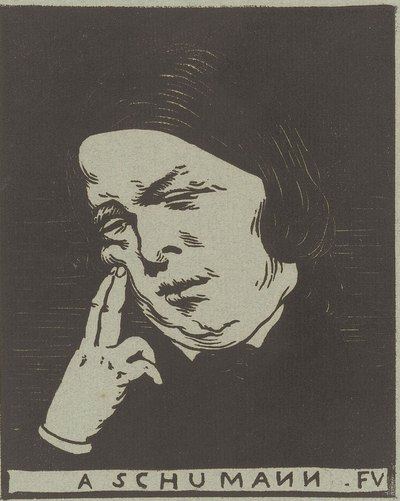 The composer of this pieceRobert Schumann1810–1856 · born in Zwickau, Germany
Is this something a child practices at the piano? Many people think so, but the piece Schumann left us is a little different. Stop eight: "Träumerei," Dreaming, the seventh piece of Scenes from Childhood.
In 1838 Robert Schumann, twenty-seven, lived in Leipzig and edited a music magazine. He was also in love, with Clara, the brilliant pianist daughter of his own piano teacher, Friedrich Wieck. Wieck fiercely opposed the match, and for a time the two kept their bond alive through secret letters.
That year Schumann wrote to Clara that he had composed some thirty small piano pieces and had chosen several of them under the name Scenes from Childhood. He added that something she had once said, that he sometimes seemed like a child to her, had stayed with him and led to these pieces. The finished set has thirteen.
Each piece has a title: "Of Foreign Lands and Peoples," "Blind Man's Buff," "By the Fireside." Yet Schumann said the titles were added after the music was written. The story didn't come first; the music did, and the titles are small hints for the listener. So the set is less a children's exercise book than a grown-up's music about remembering childhood.
After a battle that went all the way to court, the two married in 1840. Think of that long wait as you listen.
Listen for this
- The first melodyone line of song swelling slowly upward, rising like a deep breath and then sinking back.
- The repeatsthis short song returns several times, and each time the harmony beneath it takes on a slightly different color.
- The endnear the close the melody pauses, hesitates, and then finishes quietly, like the moment you wake from a dream.
A question to think about
Wieck blocked the marriage out of worry for his daughter's future, and Schumann and Clara could marry only with a court's permission. Clashes between parents' worries and children's choices are still common.
When a parent's wish to protect collides with a child's right to decide their own life, from what point should the child's decision be respected?
The piece at this track
Schumann · about 3 min
Recording on its way