
VOL. 11 · Track 5 · 5 / 15
Who Named It Moonlight?
Beethoven called it a "sonata in the manner of a fantasy." The moonlight came later, from a poet's imagination.
Until membership opens, all fifteen stories stay free.
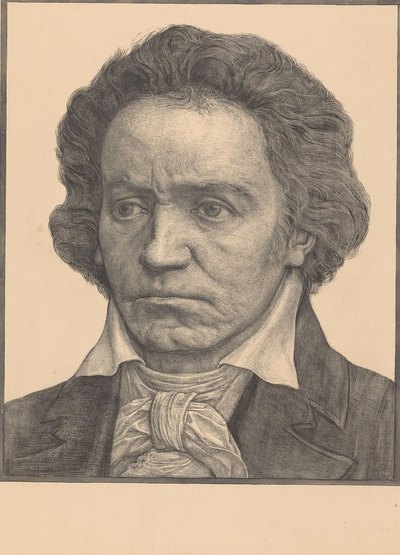 The composer of this pieceLudwig van Beethoven1770–1827 · born in Bonn, Germany
A pianist's right hand rolls the same three notes over and over. Three, three, and three again. Above them, a low, slow song rises, barely audible. This is the fifth stop: Beethoven's Piano Sonata No. 14.
Almost everyone knows it, as the "Moonlight Sonata." Yet when the score came out in Vienna in 1802, the title on the cover read "Sonata quasi una fantasia," a sonata in the manner of a fantasy. Moonlight was nowhere to be seen. The nickname is said to come from the poet and critic Ludwig Rellstab, who, after Beethoven's death, compared the first movement to moonlight on Lake Lucerne in Switzerland.
Why "in the manner of a fantasy"? Sonatas of the time usually began with a fast, vigorous movement. This one opens slowly and quietly, gathers speed, and ends with a last movement that rages like a storm. It follows its own feeling more than the usual pattern, hence a sonata like a fantasy.
In 1801, when he was writing it, Beethoven was thirty. That year, in a letter to his old friend Wegeler, he confessed a secret: for several years his hearing had been failing. What could be more frightening for a musician? He dedicated the sonata to a young countess he taught, Giulietta Guicciardi.
At the top of the first movement Beethoven wrote that the whole movement must be played very delicately, and without lifting the dampers. He wanted the sounds to overlap and blur on purpose.
Listen for this
- The openingthe right hand's groups of three flow like ripples without pause. They never stop until the movement ends.
- When the song entersover the ripples, a low melody appears, repeating one note in short and long values.
- The endingthe left hand sinks very low, and the sound fades away to nothing.
A question to think about
Beethoven hid his deafness for a long time, afraid it would end his career as a musician. Today, too, many people keep physical or mental difficulties to themselves for fear of losing work or reputation.
For someone to speak openly about a weakness, what would the society around them need to change?
The piece at this track
Beethoven · I. Adagio sostenuto · about 6 min
Recording on its way