
VOL. 11 · Track 4 · 4 / 15
Night Music Its Composer May Never Have Heard
Mozart entered this serenade in his catalogue in August 1787. Yet there is no record of it being played in his lifetime.
Until membership opens, all fifteen stories stay free.
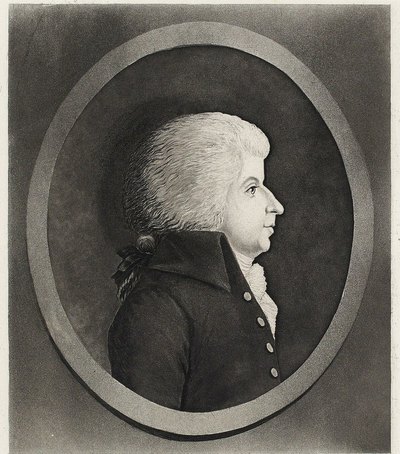 The composer of this pieceWolfgang Amadeus Mozart1756–1791 · born in Salzburg, Austria
Vienna, 10 August 1787. Mozart, thirty-one, opens a small notebook. For three years he had been logging every work he finished there, with the date and the first few bars. That day he wrote: "A little night music." In German, Eine kleine Nachtmusik.
Welcome to the fourth stop. Mozart was extremely busy at this time. He was writing Don Giovanni, due for its premiere in Prague that autumn, and in May he had lost his father, Leopold. It is hard to believe that a serenade this bright and tidy came out of such a summer.
A serenade was music for evenings and open air, or for parties. But no one knows who this one was for or where it was meant to be played. There is no record of it being performed while Mozart was alive. It was not published until 1827, long after his death.
There is another mystery. Mozart's catalogue lists the piece in five movements, but we hear only four. A minuet that once stood second is missing. Where the page that held it went, no one knows.
Now let's hear the first movement. The moment it starts, every instrument lines up and leaps upward together, as if bounding up a staircase. It sounds like someone flinging open a door and calling out, "Good evening!"
Listen for this
- The openingall the strings surge upward on the same notes, a bold greeting. Even if you don't know the title, you'll recognize it.
- The second themewhen the first theme steps back, a softer, more graceful tune appears. Listen for the contrast between bold and elegant.
- The returnafter the themes are turned this way and that in the middle, the opening greeting comes back in full force.
A question to think about
Mozart wrote this piece into his catalogue, but there is no trace of a performance, and one movement has vanished. Even so, it has become one of the most often heard pieces in the world. Many works outlived the people who made them before they found success.
Should the value of someone's work be recognized during their lifetime, or is it enough for it to come to light later?
The piece at this track
Mozart · I. Allegro · about 6 min
Recording on its way