
Details
- Composer
- Antonín Dvořák
- Catalogue no.
- Op. 95
- Key
- E minor
- Scoring
- Orchestra
- Length
- about 10 min
Recording
Morning music at 7
About this piece
December 1893, Carnegie Hall in New York. When a Czech composer's new symphony was played for the first time, it is said the audience applauded after every movement. It was the Ninth Symphony, 'From the New World'.
At a glance
- What it isthe first movement of Symphony No. 9. It begins with a slow Adagio introduction and continues Allegro molto, very fast.
- Who, when, whywritten in 1893 by the fifty-two-year-old Dvořák while he was living in New York. The New York Philharmonic gave the first performance that December.
- What to listen forthe first theme shouted by the horns, and the third theme sung by the flute.
Listen for
- The introductionthe cellos sing quietly, then the orchestra suddenly bursts out and creates tension.
- The horns' callwhen the fast section begins, the horns shout a vigorous theme that leaps upward. It returns many times, right through to the last movement.
- The flute's songthe gentle theme sung by the flute is often said to resemble the African American spiritual 'Swing Low, Sweet Chariot'.
When it was written
In 1892 Dvořák went to America at the invitation of the National Conservatory of Music in New York, to serve as its director. The conservatory's founder, Jeannette Thurber, asked him to guide young composers toward a music of America's own. Dvořák took an interest in African American spirituals and the music of Native Americans, and said that the foundation of American music lay in such songs.
Yet he did not lift actual folk songs into this symphony. He explained that he wrote his own melodies in the spirit of those songs. His longing for his native Bohemia also runs through it, so the piece became music that looks at both the new world and home.
A question to think about
In America Dvořák looked for the roots of American music in spirituals and Native American music. In the society of the time, the people who sang those songs faced discrimination.
Whose songs should represent a society's culture? When the culture of people who faced discrimination is recognized as a nation's culture, what is needed for their lives to be respected as well?
The composer
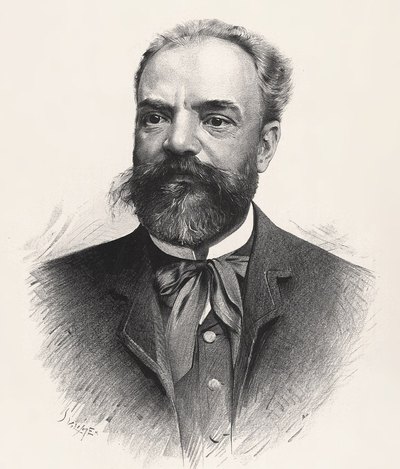 Antonín Dvořák1841–1904 · born in Nelahozeves, Czech RepublicMore on Dvořák →
For moods like
Stuck · Lonely
slow · minor key · energy 2
Find more pieces in Listen by Mood →