
Who Was Elise?
The original manuscript of Für Elise is lost, and the name survives only through one scholar's transcription. Elise remains a mystery.
E, D-sharp, E, D-sharp, E, B, D, C, A. Even people who never learned the piano know those first nine notes by heart. Yet nobody knows for certain who the "Elise" of this famous piece was.
A piece Beethoven never released
Surprisingly, Beethoven never published it in his lifetime, and it has no opus number. Today it is catalogued as a Bagatelle in A minor; "bagatelle" means a trifle, a short, light piece.
It came to light only in 1867, forty years after Beethoven's death. The German music scholar Ludwig Nohl saw Beethoven's autograph in a woman's house, copied it, and printed it in a book. Nohl reported that the page was inscribed: "For Elise, on 27 April, as a remembrance of L. v. Beethoven."
After that, the autograph vanished. All that remains is Nohl's transcription and a few sketch leaves Beethoven jotted while working on the piece around 1810.
Detective work around one name
So even the name "Elise" reaches us only through Nohl's eyes. That is where the detective work began.
The most widely repeated theory holds that the name was really "Therese," and that Nohl misread Beethoven's notoriously difficult handwriting. The woman whose copy Nohl saw said she had inherited it from Therese Malfatti, a young woman Beethoven is known to have considered proposing to around 1810.
But there are other candidates. Research has turned up singers and girls in Beethoven's circle who actually went by Elise or Elisabeth, and the question is still unsettled. What is certain is that this puzzle over a single name has kept a small piece on people's lips for even longer.
Listening again
Many people remember only the familiar opening, but the piece changes mood sharply twice: once into a bright, gentle major key, and once into a restless passage where the left hand pounds a single repeated note. Each time the opening tune returns in between, notice how welcome it feels.
A question to think about
Because the original is lost, the name of Für Elise depends entirely on one person's transcription, and there is no longer any way to check whether it was right. Much of the information we read today has likewise been copied or summarized by someone, and originals disappear easily.
How far should we trust a record whose original can't be checked? And who should be responsible for preserving the originals of records that matter?
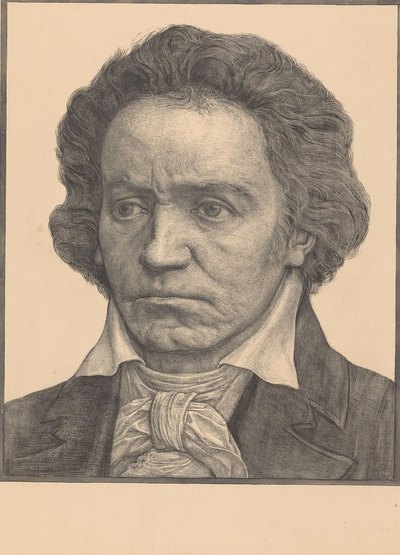
Ludwig van Beethoven1770–1827Read the story of Beethoven →