
VOL. 06 · Track 9 · 9 / 15
The Favorite
A B-flat major piano rag Scott Joplin published in 1904, with ragtime's steady left hand and a right hand that slips just off the beat above it.
 VOL. 06
 The Other Joplin조플린의 또 다른 얼굴
This track plays with a membership. Tracks 1 and 2 are open to everyone.About membership
 The composer of this pieceScott Joplinc. 1868–1917
About this piece
What were you hoping for if you called a piece The Favorite? The word can mean the thing you cherish most, or the one everybody picks. Perhaps the hope was that pianists everywhere would keep reaching for it. Scott Joplin published this piano rag in B-flat major in 1904. Let's listen and see whether it earns its name in our ears too.
At a glance
- What it isa ragtime piece for solo piano, lasting about three minutes.
- Who and whenwritten by Scott Joplin and published in 1904, in the key of B-flat major.
- What to listen forthe steady walk of the left hand, the right hand slipping just off the beat above it, and the moments when a new section begins.
Listen for
- The left hand's walkin a classic rag the left hand usually alternates a low bass note and a chord, stepping evenly in two with an oom-pah. It is a step inherited from the march, and that even floor is what lets the right hand's play stand out.
- Right-hand syncopationsyncopation means putting the stress where the strong beat isn't, so the rhythm seems to slip off the beat and tug forward. Listen for where the right hand drifts away from the left and then lands together with it again.
- When sections changerags are usually built from several sections of similar length that follow one another and repeat. Notice how the height of the tune or the mood shifts as a new section comes in.
When it was written
Ragtime is music that grew up among African American musicians in the late nineteenth century. It laid syncopation over the frame of the march and sold widely as piano sheet music. Recordings were not yet common, so people bought the music and tried out new rags at the piano at home.
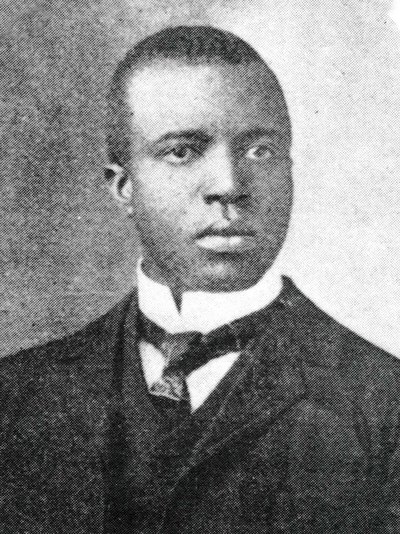
Joplin was born in Texas around 1868. His father, who had been enslaved, worked on the railroad, and his mother did domestic work. As a young man Joplin travelled the Midwest playing piano, and in the 1890s he settled in Sedalia, Missouri. The Maple Leaf Rag made his name in 1899, and The Entertainer followed in 1902. By 1904, when this piece came out, he was publishing rags steadily.
Joplin also cared about how ragtime should be played. In 1908 he published School of Ragtime, a set of exercises for players, and in 1911 he published his opera Treemonisha at his own expense. He never saw it properly staged in his lifetime. By the time he died in New York in 1917, public taste was already moving toward jazz.
A question to think about
This piece is called The Favorite. Yet by the time Joplin died his rags had fallen out of fashion, and it was in the 1970s that they were widely loved again, with the 1973 film The Sting, which used his music, playing a big part. In 1976, nearly sixty years after his death, he was awarded a special Pulitzer Prize.
Who decides what counts as a favorite, and when? If a piece of music, or a person, is overlooked today, where does their worth wait until someone discovers it again?