
VOL. 06 · Track 8 · 8 / 15
Weeping Willow
A Scott Joplin rag in G major, published in 1903, where an evenly walking left hand meets right-hand off-beats that sway like drooping branches.
 VOL. 06
 The Other Joplin조플린의 또 다른 얼굴
This track plays with a membership. Tracks 1 and 2 are open to everyone.About membership
 The composer of this pieceScott Joplinc. 1868–1917
About this piece
Weeping Willow. The name sounds sad, but in English it simply describes a tree whose branches hang down towards the ground. So is this a sad piece? Once the left hand starts its steady walk, the right hand sways just off the beat, slipping between the steps. It is a rag Scott Joplin published in 1903.
At a glance
- What it isa ragtime piece for solo piano, in G major.
- Who and whenwritten by Scott Joplin and published as sheet music in 1903, the year after The Entertainer came out.
- What to listen forthe even walk of the left hand, the right hand slipping off the beat, and the moments when a new section begins.
Listen for
- The left hand's walkin a classic rag the left hand usually alternates a low note and a chord. This oom-pah step holds up the floor of the piece. Listen for whether it stays steady however much the right hand sways.
- Right-hand syncopationsyncopation is rhythm that pushes a little ahead of a strong beat or leaves it empty. Try picturing willow branches moving a beat behind the wind as you listen.
- When sections changerags are usually built from several short sections that follow one another and repeat. Listen for how the height and feel of the melody shift when a new section comes in.
When it was written
Ragtime is piano music that grew up among African American musicians in the late nineteenth century. It laid off-beat rhythms over the tidy frame of the march, sold widely as sheet music and became a great craze. People bought the music and tried the newest rags on the piano at home.
Joplin made his name in 1899 with the Maple Leaf Rag, and afterwards moved to St. Louis, where he kept on composing. The Entertainer appeared in 1902, and this piece followed in 1903. Joplin is known to have urged players not to play ragtime fast. See whether the off-beats come through more clearly when nobody is in a hurry.
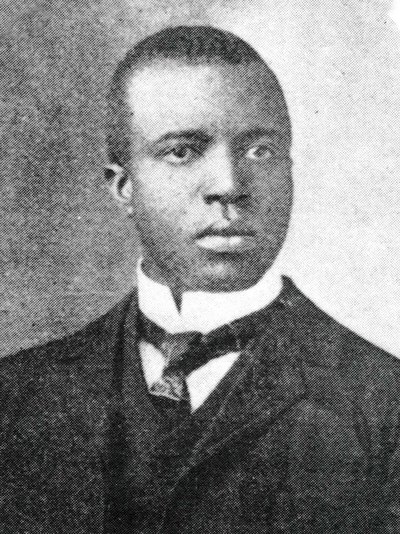
Scott Joplin
Joplin was born in Texas around 1868. His father, a railroad labourer, had been born into slavery. As a young man he travelled the Midwest as a pianist, and in the 1890s he lived in Sedalia, Missouri.
In 1911 he published the score of his opera Treemonisha at his own expense, but he never saw a proper performance of it in his lifetime. After he died in New York in 1917, his music was forgotten for a while. It became widely known again through the 1973 film The Sting, and in 1976 he was awarded a special Pulitzer Prize.
A question to think about
Joplin named this piece after a weeping willow. Yet what reaches the ear first is an evenly walking left hand and a right hand that keeps slipping off the beat. The feeling a name gives us and the sound we actually hear are not always the same.
We often judge people and things by their names or by first impressions too. When the feeling a name gave you and the feeling you got from really listening turn out to be different, which one do you want to trust more?