
VOL. 06 · Track 11 · 11 / 15
Leola
A Joplin rag in A-flat major published in 1905: under a title that sounds like a person's name, the right hand steps just off the beat above an oom-pah left hand.
 VOL. 06
 The Other Joplin조플린의 또 다른 얼굴
This track plays with a membership. Tracks 1 and 2 are open to everyone.About membership
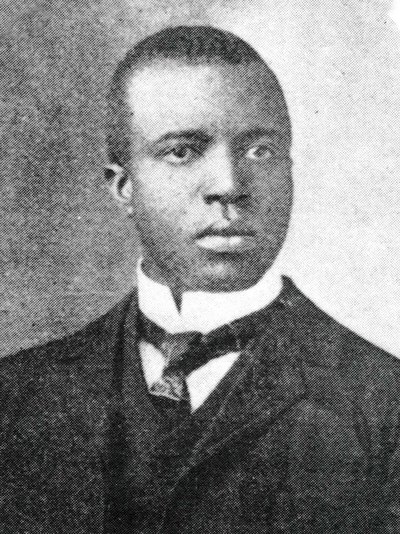 The composer of this pieceScott Joplinc. 1868–1917
About this piece
Leola. The title sounds like someone's name, so who was this person? The title gives us only the name, and the music says nothing about them. Instead, the left hand walks steadily while the right hand steps lightly around the beats. It is a rag Scott Joplin published in 1905.
At a glance
- What it isa ragtime piece for piano in A-flat major.
- Who and whenwritten by Scott Joplin and published in 1905, six years after the Maple Leaf Rag made his name.
- What to listen forthe even walk of the left hand, the right hand twisting the beat above it, and the moments when a new section begins.
Listen for
- The walking left handin a classic rag the left hand usually alternates a low bass note with a chord in the middle of the keyboard. This oom-pah, oom-pah step holds up the whole piece.
- The right hand stepping aside: the right hand finds its lilt through syncopation, placing accents a little ahead of the beat or holding them back. Pick one note that pulls against the left hand's step and follow it.
- When the sections change: rags are usually built from a few sections of similar length that follow one another and repeat. Listen for whether the melody rises or brightens when a new section comes in.
When it was written
Ragtime is piano music that grew up among African American musicians in the late nineteenth century. It laid syncopated rhythm over the tidy frame of the march. In the days before radio, people bought the sheet music for new rags and played them on the piano at home.
Joplin was born around 1868 in Texas, and as a young man he travelled the Midwest playing piano. In the 1890s he lived in Sedalia, Missouri, and in 1899 the publication of the Maple Leaf Rag made his name. That piece is also in A-flat major, like Leola. A-flat major has four flats in its key signature, so on the piano the hands visit the black keys often.
Joplin believed ragtime should be learned and played with care. In his 1908 instruction book, School of Ragtime, he warned players not to play ragtime fast. He moved to New York around 1907 and died there in 1917. His music was forgotten for a time, then won a wide audience again when it was used in the 1973 film The Sting.
A question to think about
Leola sounds like a person's name, yet the piece holds no face and no story of theirs. What reaches us is a melody in A-flat major, and a right hand stepping off the beat above an oom-pah left hand.
What might it mean to put someone's name on a piece of work? If you left a song, a story or a picture named after someone you care about, what would you hope a stranger, seeing only that name a hundred years from now, would feel?