
VOL. 01 · Track 10 · 10 / 15
Symphony No. 3 · III. Poco allegretto
A wistful, waltz-like melody first sung by the cellos, at the heart of the shortest of Brahms's symphonies.
 VOL. 01
 Your First Music Journey처음 떠나는 음악 여행
This track plays with a membership. Tracks 1 and 2 are open to everyone.About membership
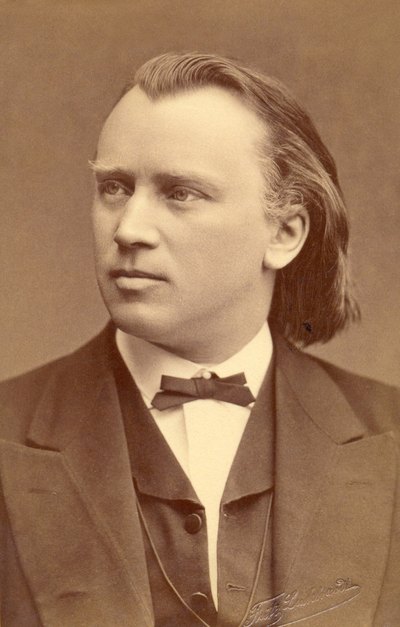 The composer of this pieceJohannes Brahms1833–1897 · born in Hamburg, Germany
About this piece
It is neither a vigorous dance nor a slow song, more like a memory walking a little briskly. The cellos are first to bring that memory out.
At a glance
- What it isthe third movement of Brahms's Symphony No. 3 in F major. Instead of the fast scherzo usually found here, he placed a wistful movement at an easy pace.
- Who, when, whyBrahms wrote it in summer 1883 in Wiesbaden, Germany, and premiered it in Vienna that December.
- What to listen forthe cellos' opening melody, the woodwind middle section, and the passage where the horn sings the same tune again.
Listen for
- The first melodythe cellos sing a longing minor-key tune, gently supported by swaying strings.
- The middle sectionthe woodwinds trade a different, hesitant phrase.
- The returnthe opening melody comes back, this time on the horn, then on oboe and violins. Enjoy hearing the same song in different voices.
When it was written
Brahms approached the symphony with such caution that he did not present his first until he was forty-three, reportedly because he was always aware of Beethoven's enormous shadow. The Third, by contrast, came relatively quickly, and became an unusual symphony in which all four movements end quietly.
In 1883 Brahms was fifty and enjoyed great fame as a German-born composer settled in Vienna. The premiere was given by the Vienna Philharmonic under Hans Richter. The melody of this third movement later appeared in films and songs, making it widely known even to people who don't know the symphony.
A question to think about
Brahms is said to have delayed his first symphony for years because he was so conscious of a great predecessor. Comparing ourselves with others can drive us to do better, but it can also keep us from starting at all. Today we see others' achievements endlessly online.
When does comparing ourselves with others become a force that helps us grow, and when a burden that stops us? What makes the difference?