
Details
- Composer
- Antonio Vivaldi
- Catalogue no.
- RV 293
- Key
- F major
- Scoring
- Violin and orchestra
- Length
- about 3 min
Recording
Morning music at 7
Track info
「Concerto No. 3」Performed by John Harrison (violinist)Wikimedia CommonsCC BY-SA 4.0
About this piece
At dawn hunters set out with horns, guns and hounds. The beast flees, and the hunters give chase. The last movement of 'Autumn' in The Four Seasons depicts the hunt.
At a glance
- What it isthe third and last movement of 'Autumn' from The Four Seasons, a fast Allegro subtitled 'The Hunt'.
- Who, when, whythe finale of the 'Autumn' concerto in Vivaldi's collection published in 1725.
- What to listen forthe horn calls imitated by the orchestra, and the hunted beast depicted by the solo violin.
Listen for
- Hornsthe orchestra begins with a brisk theme in three that sounds like hunting horns.
- The chasethe solo violin runs up and down quickly, depicting the fleeing beast, while the orchestra cuts in as if imitating gunshots and barking dogs.
- Collapsewhere the beast falls exhausted, the solo violin's figures grow weaker, and at the end the hunters' theme returns to close.
When it was written
The Four Seasons are the first four concertos of Il cimento dell'armonia e dell'inventione, a collection Vivaldi published in Amsterdam in 1725. Each comes with a sonnet describing its season, and the score marks which line of the poem each passage depicts. The sonnets are sometimes thought to be by Vivaldi himself, but this is not certain.
For the aristocrats of Vivaldi's time hunting was a pleasant pastime, and the horn call was the sound that most called it to mind. The sonnet for this movement describes not only the hunters but the beast as well, terrified, exhausted and wounded.
A question to think about
Vivaldi's sonnet depicts both the hunters' pleasure and the suffering of the beast chased until it falls. The same scene looks entirely different depending on whose eyes we see it through.
What do you think about animals suffering for human pleasure? What can we do in our daily lives today to reduce the suffering of animals?
The composer
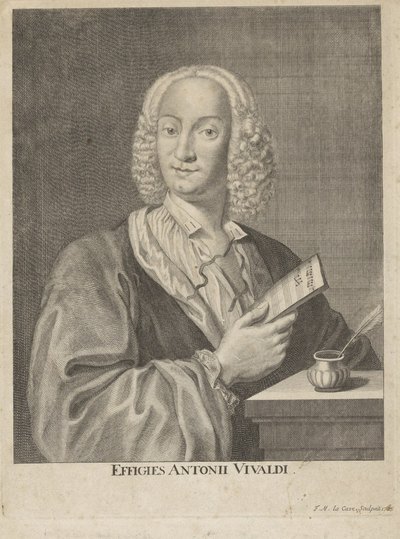 Antonio Vivaldi1678–1741 · born in Venice, ItalyMore on Vivaldi →
For moods like
Restless · Excited
fast · major key · energy 5
Find more pieces in Listen by Mood →