
Details
- Composer
- Ludwig van Beethoven
- Catalogue no.
- Op. 60
- Key
- B-flat major
- Scoring
- Orchestra
- Length
- about 10 min
Recording
Morning music at 7
About this piece
Beethoven's Fourth Symphony is less known, squeezed between the grand Third, the Eroica, and the forceful Fifth. Yet its second movement holds one of the finest songs among his slow music.
At a glance
- What it isthe second movement of Symphony No. 4, a slow Adagio in E-flat major in three beats.
- Who, when, whyBeethoven wrote it in 1806, at about thirty-six, and dedicated it to Count Oppersdorff.
- What to listen forthe 'da-dum' rhythm repeated in the accompaniment, and the long, gentle melody above it.
Listen for
- The first barthe second violins quietly tap out a rhythm pairing a short note with a long one. It returns throughout the movement like a heartbeat.
- The songabove it, the first violins sing a long, gentle melody.
- The clarinetaround the middle, the clarinet sings alone. It is a moment when the orchestra holds its breath and gives its ear to a single instrument.
When it was written
In the summer and autumn of 1806 Beethoven stayed at the Silesian castle of his patron Prince Lichnowsky. There he met Count Oppersdorff, who asked for a symphony, and Beethoven dedicated this one to him. At the time, despite the torment of his worsening hearing, he was producing large works one after another, including the Violin Concerto and the Fourth Piano Concerto.
The Fourth Symphony was first performed in March 1807 at a private concert in Prince Lobkowitz's palace in Vienna. Schumann later, it is said, likened it to a slender Greek maiden standing between two giants.
A question to think about
Squeezed between famous symphonies on either side, the Fourth long drew less attention. Yet it holds a movement as beautiful as this one. Attention tends to go first to what is big and strong.
Why do we turn first to what is big and intense? What attitude do we need for quiet but valuable things to be properly seen?
The composer
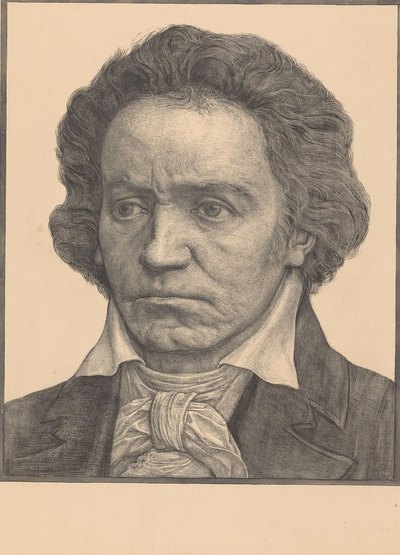 Ludwig van Beethoven1770–1827 · born in Bonn, GermanyMore on Beethoven →
For moods like
Calm · Grateful · Focused
slow · major key · energy 2
Find more pieces in Listen by Mood →