
VOL. 05 · Track 10 · 10 / 15
Grace and Beauty
The A-flat major piano rag James Scott published in 1909, one of the pieces that made his name: hear a right hand ranging across the keyboard and playing across the beat above a steady left hand.
 VOL. 05
 Ragtime: Joplin and Scott래그타임 — 조플린과 스콧
This track plays with a membership. Tracks 1 and 2 are open to everyone.About membership
About this piece
Picture a music store with a piano in the corner and a young man playing the newest sheet music for customers. Before radio and records were common, this was how people heard a tune before buying it. A few years later that young man, James Scott, published a rag called Grace and Beauty. It appeared in 1909 and became one of the pieces that made his name. What was it about this music that caught people's ears?
At a glance
- What it isa ragtime piece for solo piano in A-flat major.
- Who and whenpublished in 1909 by James Scott, a composer from Missouri.
- What to listen fora steady left hand, and a right hand that ranges widely over the keyboard while playing across the beat.
Listen for
- The left hand keeping step: a low note and a chord take turns in an even 'oom-pah' that lays the floor. Follow the left hand alone for a moment and you can hear how steadily the piece walks.
- The right hand slipping past the beat: when the weight falls off the strong beats, that is syncopation. Each time the right hand pops out between beats, the music seems to bounce.
- The whole keyboardScott's rags are known as showy pieces that use a wide stretch of the keyboard. Listen for how far apart the high and low notes ring.
When it was written
Ragtime is piano music that grew up among African American musicians in the late nineteenth century. In those years, buying sheet music and playing it on a piano at home was a common way to enjoy music.
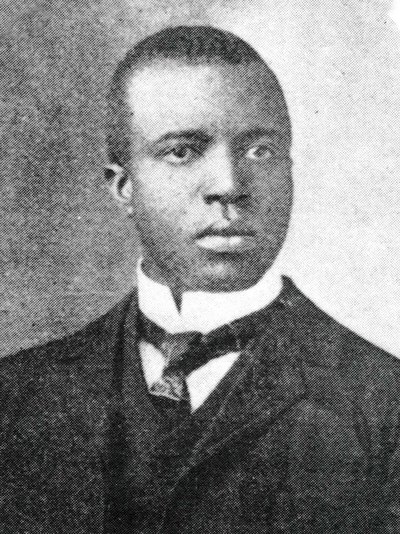
James Scott was born around 1885 in Neosho, Missouri. He had little formal training and is said to have taught himself most of what he knew at the piano. In his late teens he moved with his family to Carthage, where he started out doing odd jobs at a music store and went on to demonstrate new sheet music. His first pieces were published in Carthage.
Around 1906 Scott is said to have met Scott Joplin in St. Louis, and Joplin is said to have introduced him to the publisher John Stark. Stark brought out Frog Legs Rag in 1906, and most of Scott's later music came out through Stark. Grace and Beauty followed three years later.
The composer James Scott
Today Scott is counted with Joplin and Joseph Lamb as one of the big three of classic ragtime. Just the pieces of his you can hear on this site tell the story: Sunburst in the same year, 1909, Ophelia in 1910, and Victory in 1921. He kept publishing rags for more than a decade.
In the late 1910s the ragtime craze gave way to jazz. Around 1919 or 1920 Scott moved to Kansas City, where he taught music and accompanied silent films in theaters. As sound films spread in the late 1920s, those theater jobs dwindled, and he died in Kansas City in 1938. His rags came back into the repertoire as ragtime was rediscovered from the mid-twentieth century on.
A question to think about
Scott began his working life playing new sheet music in a store, and later earned his living giving silent films a soundtrack in theaters. Then sound films spread, and that work grew scarce.
When a new technology makes some people's jobs disappear, what does a society owe them? If work you cared about were taken over by a machine, how would you feel, and what would you want others to do?