
VOL. 11 · Track 15 · 15 / 15
An Experiment With One Melody to the End
Ravel wrote Boléro at the request of the dancer Ida Rubinstein. Same tune, same drum rhythm; only the instruments change.
Until membership opens, all fifteen stories stay free.
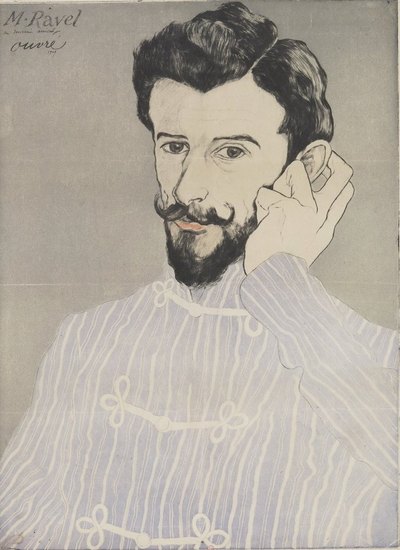 The composer of this pieceMaurice Ravel1875–1937 · born in Ciboure, France
On a quiet stage, a single snare drum taps out a rhythm, very softly but without a single pause. Above it, a flute begins the melody alone. The last stop, number fifteen: Maurice Ravel's Boléro.
It began as ballet music. The Russian-born dancer Ida Rubinstein asked Ravel for Spanish-flavored music for her company, and it was first staged in November 1928 at the Paris Opéra. The bolero is a Spanish dance.
Ravel ran a daring experiment. From beginning to end the snare drum repeats the same rhythm, and the melody is really just two tunes taking turns. The harmony barely moves. So what changes? The instruments and the volume. Flute, then clarinet, then bassoon, then the little E-flat clarinet: the same melody returns again and again in new clothes, growing just a little louder each time.
Ravel was a master at mixing colors of sound. At one point, a horn, a celesta and two piccolos play the melody together at different pitches. Strangely, you don't hear four instruments but one you've never heard before, something like an organ, or an unfamiliar machine.
Then, near the end, the key, which has stayed put the whole time, shifts just once. At that moment all the sound that has piled up bursts and collapses, and the piece is over. Beyond this door is the curtain call. Thank you for walking all fifteen stops with me.
Listen for this
- The openingthe snare drum's rhythm with the flute above it. It is very quiet, so listen closely.
- The blended soundthe passage where horn, celesta and piccolos sing the melody together. See whether it sounds like a single instrument.
- The endingdon't miss the sudden one-time change of key, and the final collapse of all the sound at once.
A question to think about
Boléro repeats the same rhythm and melody endlessly, yet instead of boring us it draws us in deeper and deeper. Today, by contrast, we can lose hours in front of screens where short videos and notifications repeat without end.
When the power of repetition to hold people becomes art, and when it becomes a trap, what separates the two?
The piece at this track
Ravel · about 15 min
Recording on its way