
VOL. 11 · Track 1 · 1 / 15
A King's Music on the River
On a summer evening in 1717, a barge full of musicians followed the king's boat up the Thames.
Until membership opens, all fifteen stories stay free.
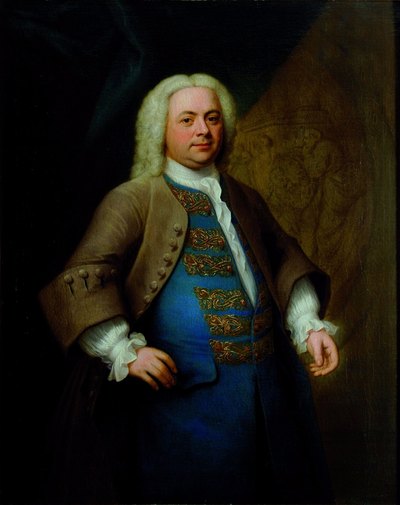 The composer of this pieceGeorge Frideric Handel1685–1759 · born in Halle, Germany
London, July 1717. Boats are drifting out onto the Thames as the evening cools. In the large covered barge sit King George I and his guests. Right beside them, keeping pace, is another barge carrying nothing but musicians.
Welcome to the first stop. I'm Bach, your guide. The man who wrote tonight's music, Handel, was born in Germany in 1685, the same year as me. Yet the two of us never met. I stayed with German churches and courts; Handel went to Italy, then crossed to London and made his name there.
That night on the river made the newspapers. There were about fifty musicians, and the king liked what he heard so much that he had the music played again and again. The boats went up from Whitehall to Chelsea and back, and the playing went on late into the night.
Think about where this was happening. No walls, no ceiling. Wind, slapping water, and a crowd of boats full of curious Londoners all around. A quiet lute would simply vanish out there. So Handel reached for instruments that carry: trumpets and horns.
The piece we hear today, the Alla Hornpipe, borrows the beat of the hornpipe, a dance the English loved. Over a rhythm that almost stamps its feet, the brass flashes. Trumpets and horns of the time had no valves. Players picked out notes with their lips alone, so on a rocking barge they must have been working hard.
Listen for this
- The openingthe strings lay down the dance rhythm, and the trumpets and horns toss the tune back and forth, like voices calling across the water.
- The middle sectionthe mood shifts. After all that brilliance, the music takes a breath.
- The endingthe opening returns. Notice how good it feels when a tune you already know comes back.
A question to think about
This music was written for one man's boat party. Yet plenty of Londoners heard it for free that night from the riverbank and from their own boats, and today anyone can listen. Many things made for a privileged few end up belonging to everyone.
When something once enjoyed by a few becomes everyone's, what do we gain, and is anything lost?
The piece at this track
Handel · Suite No. 2: Alla Hornpipe · about 4 min
Recording on its way