
VOL. 09 · Track 13 · 13 / 15
String Quartet No. 6 · II. Allegro
Mendelssohn's last string quartet, written in 1847 after the death of his sister Fanny. Its second movement is a restless dance that never stops driving.
 VOL. 09
 When You Need to Focus집중이 필요할 때
This track plays with a membership. Tracks 1 and 2 are open to everyone.About membership
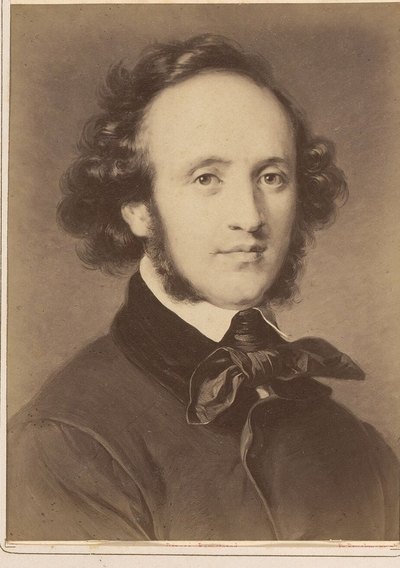 The composer of this pieceFelix Mendelssohn1809–1847 · born in Hamburg, Germany
About this piece
Mendelssohn, known for bright, poised music, cannot catch his breath here. The rhythm stumbles against the beat, and the four instruments drive on roughly.
At a glance
- What it isthe second movement, a fast Allegro assai, of String Quartet No. 6 in F minor, the last quartet Mendelssohn completed.
- Who, when, whywritten in 1847 after his sister Fanny died suddenly. That November he died too.
- What to listen forsyncopated rhythms fighting the beat, heavy repeated figures in the low instruments, and a strangely sunken middle section.
Listen for
- The openingthe four instruments charge with strong off-beat accents, a dance that seems about to trip and fall.
- The middleviola and cello repeat the same figure low down, while the violins circle uneasily above.
- The endingafter the rough dance returns, the sound cuts off abruptly.
When it was written
Fanny Mendelssohn, four years older than Felix, was herself a fine pianist and composer. Having learned music together from childhood, the two were each other's first audience all their lives. But it was then extremely hard for a woman to make a name as a composer, and some of Fanny's songs were even published under her brother's name.
When Fanny died suddenly in May 1847, Felix was devastated. This quartet, written that summer while resting in Switzerland, is rough and dark, unlike anything else he wrote. In November of the same year Mendelssohn died, at thirty-eight.
A question to think about
Fanny had talent equal to her brother's, but as a woman her path as a composer was blocked, and some of her work went out under his name. History is full of people who had talent but, because of gender or background, never got to have their names.
What responsibility does recovering and remembering the achievements of people who lost their names in history place on us today?