
VOL. 10 · Track 2 · 2 / 15
Organ Sonata in E-flat major · Movement III
An Allegro to close, running quickly. The two hands chase each other's theme while the feet keep up the support.
 VOL. 10
 When You Need a Lift기운이 필요할 때
Track info
「Organ Sonata in E-flat major」Performed by Johannes-Ernst Köhler, organistrecorded 1960Wikimedia CommonsCC BY 1.0
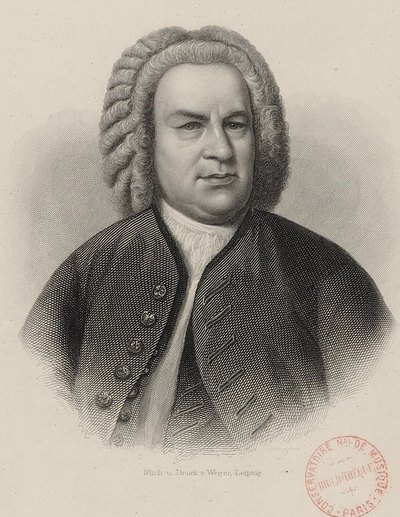 The composer of this pieceJohann Sebastian Bach1685–1750 · born in Eisenach, Germany
About this piece
After the slow second movement, Sonata No. 1 returns to bright E-flat major and closes with an Allegro, a final movement that runs at speed.
At a glance
- What it isthe third and last movement of Organ Trio Sonata No. 1, played fast.
- Who, when, whythe first piece in the set of six that Bach gathered in Leipzig around 1730. It is said to have been for his eldest son's organ practice.
- What to listen fora texture like a round, where one hand starts the theme and the other follows.
Listen for
- Setting offthe right hand gives a short, clear theme, and soon the left hand chases after it with the same theme.
- The middlethe two hands' lines cross above and below and move through other keys, while the pedal walks steadily and keeps the ground firm.
- The returneach half is repeated, and at the end the music comes home vigorously to the opening key.
When it was written
Around 1730, when this set was gathered, Bach was cantor of St Thomas's in Leipzig, responsible for church music and the school choir. At home, meanwhile, there were many children learning music. His eldest son, Wilhelm Friedemann, would later work as an organist in Dresden and Halle.
All six sonatas are in three movements, fast, slow, fast, following the order of the Italian concerto. In effect Bach brought the feel of both chamber music and concerto to a single organ.
A question to think about
While doing his church work, Bach taught music to his children at home himself, and pieces like this came out of that teaching. The household was an important place of learning in the Bach family.
Today most learning happens in schools and private academies. What might learning shared within a family offer that a school cannot? And what problems arise if such learning depends on a family's circumstances?