
VOL. 05 · Track 14 · 14 / 15
Ragtime Oriole
A piano rag in A-flat major that James Scott published in 1911: under a songbird's name, hear an even left-hand beat and a right hand that leaps across it.
 VOL. 05
 Ragtime: Joplin and Scott래그타임 — 조플린과 스콧
This track plays with a membership. Tracks 1 and 2 are open to everyone.About membership
About this piece
What would you expect to hear from sheet music with a bird's name on the cover? 'Oriole' is the name of a songbird. In 1911 James Scott, a pianist from Missouri, published a rag under that name. Is this a piece where a bird actually sings, or does the name just suggest a rhythm that hops lightly from branch to branch? The score won't tell us, but your ears can decide for themselves.
At a glance
- What it isa ragtime piece for solo piano in A-flat major.
- Who and whenpublished in 1911 by James Scott, a composer from Missouri.
- What to listen fora left hand that walks evenly and a right hand that leaps across the beat above it.
Listen for
- The left hand keeping step: in a rag, the left hand usually alternates a low note and a chord in an 'oom-pah' pattern. Follow the left hand alone and listen for whether the piece walks along as steadily as a march.
- The right hand hopping off the beat: when the weight falls somewhere other than the strong beats, that is syncopation. As the right hand pokes in between the beats, picture a bird darting from twig to twig.
- Repeat, then something new: a classic rag usually presents several sections of around sixteen bars, one after another, each played twice. Listen for whether this piece, too, has moments where a tune is heard a second time and the music turns to a new one.
When it was written
Ragtime grew up among African American musicians in the late nineteenth century. Radio and records were not yet common, so people bought sheet music and played it themselves on the piano at home. Music stores had pianists who played new pieces for customers.
James Scott
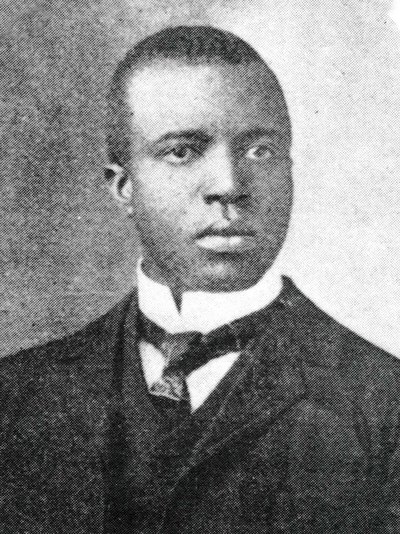
Scott was born around 1885 in Neosho, Missouri. He had little formal training and is said to have taught himself most of what he knew at the piano. In his late teens his family moved to Carthage, where he started out doing odd jobs in a music store and went on to play new sheet music for customers. His first pieces were published in Carthage.
Around 1906 he is said to have met Scott Joplin in St. Louis, and Joplin is said to have introduced him to the publisher John Stark. Grace and Beauty, published in 1909, made his name, and this piece followed two years later. Today Scott is counted with Joplin and Joseph Lamb as one of the big three of classic ragtime.
By the late 1910s the ragtime craze had given way to jazz. Scott moved to Kansas City, where he taught music and accompanied silent films in theaters, and he died there in 1938. Interest in ragtime revived after the mid-twentieth century, and his rags are played again today.
A question to think about
Scott learned the piano with little formal training and found his way as a musician by playing new pieces for customers in a music store. The rag he published in 1911 carries the name of a songbird.
Even when music does not imitate a sound we know, can a title change the way we listen? Do you prefer to know a piece's name before you hear it, or to listen first with nothing to guide you?